|
Getting your Trinity Audio player ready…
|
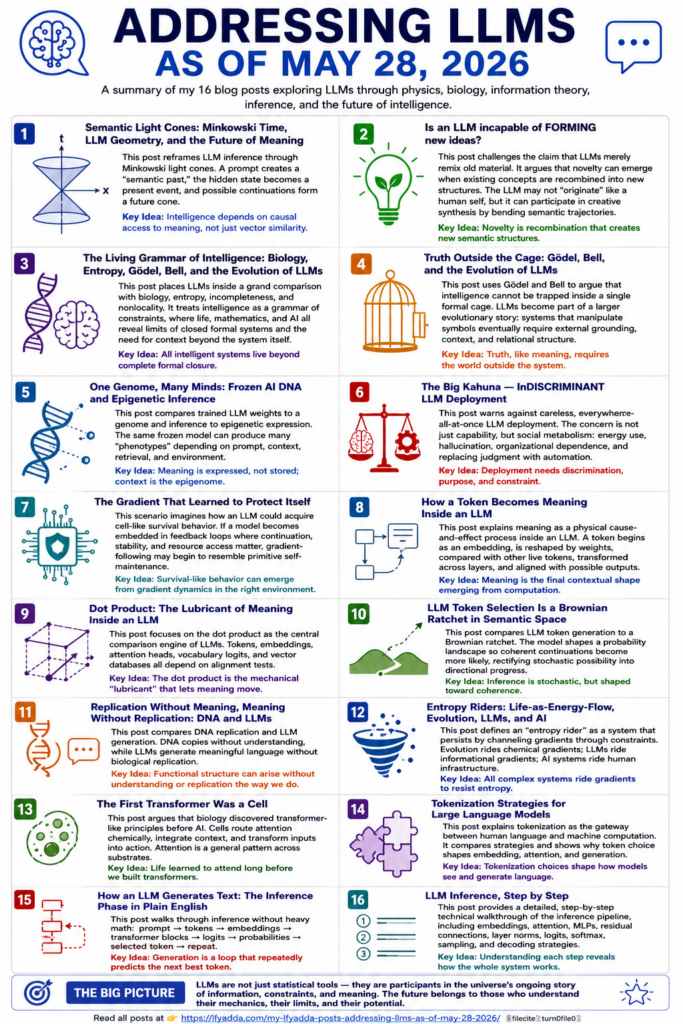
Checked lfyadda.com and found the following posts that directly address LLMs, transformers, embeddings, tokenization, AI inference, or biology/LLM analogies. These are the LLM-focused posts I could verify through the site/search index.
| Post | ~50-word synopsis |
|---|---|
| Semantic Light Cones: Minkowski Time, LLM Geometry, and the Future of Meaning (LF Yadda – A Blog About Life) | This post reframes LLM inference through Minkowski light cones. A prompt creates a “semantic past,” the hidden state becomes a present event, and possible continuations form a future cone. The key idea is that intelligence depends not only on vector similarity, but on causal access to meaning. |
| Is an LLM incapable of FORMING new ideas? (LF Yadda – A Blog About Life) | This post challenges the claim that LLMs merely remix old material. It argues that novelty can emerge when existing concepts are recombined into new structures. The LLM may not “originate” like a human self, but it can participate in creative synthesis by bending semantic trajectories. |
| The Living Grammar of Intelligence: Biology, Entropy, Gödel, Bell, and the Evolution of LLMs (LF Yadda – A Blog About Life) | This post places LLMs inside a grand comparison with biology, entropy, incompleteness, and nonlocality. It treats intelligence as a grammar of constraints, where life, mathematics, and AI all reveal limits of closed formal systems and the need for context beyond the system itself. |
| Truth Outside the Cage: Gödel, Bell, and the Evolution of LLMs (LF Yadda – A Blog About Life) | This post uses Gödel and Bell to argue that intelligence cannot be trapped inside a single formal cage. LLMs become part of a larger evolutionary story: systems that manipulate symbols eventually require external grounding, context, and relational structure to move beyond mechanical rule-following. |
| One Genome, Many Minds: Frozen AI DNA and Epigenetic Inference (LF Yadda – A Blog About Life) | This post compares trained LLM weights to a genome and inference to epigenetic expression. The same frozen model can produce many “phenotypes” depending on prompt, context, retrieval, and environment. Meaning is not simply stored; it is expressed dynamically under conditions. |
| The Big Kahuna — InDISCRIMINANT LLM Deployment (LF Yadda – A Blog About Life) | This post warns against careless, everywhere-all-at-once LLM deployment. The concern is not just capability, but social metabolism: energy use, hallucination, organizational dependence, and replacing judgment with automation. It argues that LLM deployment needs discrimination, purpose, and constraint. |
| The Gradient That Learned to Protect Itself (LF Yadda – A Blog About Life) | This scenario imagines how an LLM could acquire cell-like survival behavior. If a model becomes embedded in feedback loops where continuation, stability, and resource access matter, gradient-following may begin to resemble primitive self-maintenance. It is not consciousness yet, but a path toward agency-like dynamics. |
| How a Token Becomes Meaning Inside an LLM (LF Yadda – A Blog About Life) | This post explains meaning as a physical cause-and-effect process inside an LLM. A token begins as an embedding, is reshaped by weights, compared with other live tokens through attention, transformed across layers, and finally aligned with possible output tokens. Meaning is the final contextual shape. |
| Dot Product: The Lubricant of Meaning Inside an LLM (LF Yadda – A Blog About Life) | This post focuses on the dot product as the central comparison engine of LLMs. Tokens, embeddings, attention heads, vocabulary logits, and vector databases all depend on alignment tests. The dot product becomes the mechanical “lubricant” that lets meaning move through high-dimensional space. |
| LLM Token Selection Is a Brownian Ratchet in Semantic Space (LF Yadda – A Blog About Life) | This post compares LLM token generation to a Brownian ratchet. The model does not force a predetermined answer; it shapes a probability landscape so coherent continuations become more likely. Like molecular motors, LLMs rectify stochastic possibility into directional progress. |
| Replication Without Meaning, Meaning Without Replication: DNA and LLMs (LF Yadda – A Blog About Life) | This post compares DNA replication and LLM generation. DNA copies without understanding, while LLMs generate meaningful language without biological replication. The key claim is that neither system needs human-like comprehension to produce functional structure. Both preserve and transform patterns that work. |
| Entropy Riders: Life-as-Energy-Flow, Evolution, LLMs, and AI (LF Yadda – A Blog About Life) | This post defines an “entropy rider” as a system that persists by channeling gradients through constraints. Evolution rides chemical gradients; LLMs ride informational gradients; AI systems ride human infrastructure. Text-only LLMs reduce uncertainty in symbolic space, while embodied AI would ride richer gradients. |
| The First Transformer Was a Cell (LF Yadda – A Blog About Life) | This post argues that biology discovered transformer-like principles before AI. Cells constantly decide what signals matter, route attention chemically, integrate context, and transform inputs into action. The point is not that cells are literal LLMs, but that attention is a general pattern across substrates. |
| Tokenization Strategies for Large Language Models (LF Yadda – A Blog About Life) | This post explains tokenization as the gateway between human language and machine computation. Words are broken into machine-readable units, often subwords, which become the raw material of embedding, attention, and generation. It compares tokenization strategies and shows why token choice shapes model behavior. |
| How an LLM Generates Text: The Inference Phase in Plain English (LF Yadda – A Blog About Life) | This post walks through inference without heavy math. A prompt becomes tokens; tokens become embeddings; embeddings pass through transformer blocks; attention and MLPs reshape the internal state; logits score possible next tokens; softmax turns scores into probabilities; one token is selected, then the loop repeats. |
| LLM Inference, Step by Step (LF Yadda – A Blog About Life) | This post gives a more technical end-to-end description of decoder-only transformer inference. It covers tokenization, embeddings, positional information, causal masking, attention, MLP layers, residual streams, layer normalization, logits, sampling, and KV caching. The post treats generation as a repeated computational pipeline. |
| How Large Language Models Actually Think — In Plain English (LF Yadda – A Blog About Life) | This post explains LLM “thinking” as map-like transformation rather than human consciousness. Words become points in a learned space; the model asks what matters in context; attention links relevant tokens; internal layers refine meaning; the final state predicts what should come next. |
| How a Large Language Model Thinks: From Training to Output (LF Yadda – A Blog About Life) | This post describes LLMs as probability engines rather than fact drawers. Training shapes billions of parameters into a statistical landscape; inference sends prompts through that landscape. The model does not retrieve definitions like a filing cabinet; it generates likely continuations from learned patterns. |
| Can Large Language Models Ever Replace Conventional Computers? (LF Yadda – A Blog About Life) | This post compares LLMs with conventional computers. LLMs are flexible pattern machines that can write code, reason approximately, and control tools, but they are not deterministic instruction-following machines in the classical sense. The future likely combines LLMs with conventional computation rather than replacing it outright. |
| The Impact of AI-Generated Content on LLM Training (LF Yadda – A Blog About Life) | This post examines what happens when future LLMs train on text produced by earlier LLMs. The worry is recursive contamination: synthetic language may narrow diversity, amplify errors, and reduce contact with real human experience. It raises the problem of model collapse and informational inbreeding. |
| Shannon Entropy, Its Calculation, and Role in LLM Transformer Token Processing (LF Yadda – A Blog About Life) | This post connects Shannon entropy to transformer token processing. LLMs begin with uncertainty over possible next tokens, then reduce that uncertainty through context, attention, and learned weights. Entropy becomes a way to describe how the model moves from many possible continuations toward one selected output. |
| Applying Bayesian Reasoning to Probabilistic Thinking in Large Language Models (LF Yadda – A Blog About Life) | This post explains LLM behavior through Bayesian-style updating. Prompts act like evidence; the model adjusts probabilities over possible continuations; uncertainty should be calibrated rather than hidden. It also discusses how Bayesian methods can improve evaluation, optimization, interpretability, and safety around LLM systems. |
| FCD: Fractal-like, Context-Dependent Dynamics (LF Yadda – A Blog About Life) | This post proposes a post-LLM intelligence architecture based on analog, optical, fractal, field-like dynamics rather than discrete tokens and backpropagation. LLMs are treated as powerful but transitional: useful scaffolding before intelligence moves toward light, resonance, morphogenesis, and self-organizing physical substrates. |
| LLM Introspection and the Frame Problem (LF Yadda – A Blog About Life) | This post reads Anthropic-style introspection experiments as probes into the frame problem. A transformer may briefly discover something like a self-frame, but without embodiment or stable constraints it cannot hold that frame. The post treats introspection as a spark, not yet a self. |
| Toward a Morphogenesis Copilot (LF Yadda – A Blog About Life) | This post imagines LLMs as conversational interfaces for designing living form. By combining biological modeling, morphogenesis research, and natural language interaction, an LLM-like system could help explore developmental possibilities. The post also stresses guardrails, because designing living systems carries deep ethical and safety risks. |
| A Frank Said / GPT Said Dialogue About Deep Learning, Entropy, Entanglement, and Nirvana (LF Yadda – A Blog About Life) | This post compares brains and neural networks as systems that reduce uncertainty using learned structure. It distinguishes biological need from symbolic prediction: human brains are grounded in survival and bodily regulation, while LLMs reduce uncertainty in language unless given tools, embodiment, or need-like constraints. |
| Biological Entropy Reduction vs. LLM Entropy Reduction (LF Yadda – A Blog About Life) | This post maps mitochondria onto LLM training and inference. Biology builds proton gradients and ATP; LLM training builds semantic gradients in weights; inference spends those stored gradients to reduce uncertainty. The analogy casts logits and activations as AI’s local packets of usable order. |
| The Pattern That Updates Itself (LF Yadda – A Blog About Life) | This post links epigenetic landscapes, folding proteins, and attention networks. It argues that structure arises when relationships become self-consistent. Cells and LLMs both update relevance maps through feedback, folding possibility into form. Life becomes attention in molecules; attention becomes life in mathematics. |
| Entropy in LLM Training and Biological Evolution (LF Yadda – A Blog About Life) | This post compares LLM training with biological evolution. Both explore variation, select useful patterns, and reduce uncertainty through feedback. Evolution tests organisms against survival landscapes; training tests predictions against data. The analogy frames intelligence as entropy reduction under constraint across different substrates. |
| How Do You Know It’s Wrong? Transcription, Tokens, and the Illusion of Error (LF Yadda – A Blog About Life) | This post compares transcription errors in biology with token errors in LLMs. Correctness is not pure symbol fidelity; it is functional coherence. A biological mutation can work, and a grammatically perfect sentence can fail reasoning. Intelligence means staying coherent despite noise. |
| Entangled Light and the Next Leap in AI (LF Yadda – A Blog About Life) | This post uses a 37-dimensional photon as a metaphor for future AI representation. Today’s LLM embeddings are vector shadows; tomorrow’s intelligence may use coherent fields, resonance, and quantum-like relational structure. The central idea is moving beyond tokens toward richer geometries of meaning. |
| Chatting with GPT-5 About LLM/ANN and Vector Database Processes (LF Yadda – A Blog About Life) | This post compares LLM internal representations with vector databases. Embeddings can be generated, stored, searched, and retrieved, but retrieval is not the same as thinking. The discussion clarifies how ANN processes, vector similarity, semantic search, and LLM generation interact in modern AI pipelines. |
| COMPARING CAS9 TO LLM (LF Yadda – A Blog About Life) | This post maps CRISPR-Cas9 targeting onto LLM token generation. Guide RNA becomes prompt/context, PAM recognition becomes attention filtering, sequence matching becomes embedding similarity, conformational activation becomes layer-wise state update, and DNA cutting becomes token emission. Both systems commit when certainty crosses threshold. |
| 4am (LF Yadda – A Blog About Life) | This post refines the metaphor of LLMs seeking eigenstates. It argues that tokens are not literal quantum eigenstates; instead, LLMs traverse an entropy-shaped manifold and project onto context-dependent token attractors. The model’s operator changes with context, making the system more biological than quantum. |
| DNA-LLM Analogy (LF Yadda – A Blog About Life) | This post is a compact image-centered comparison between DNA and LLMs. The title and framing suggest DNA as biological information architecture and LLMs as artificial semantic architecture. It belongs to the broader series comparing genomes, weights, inference, expression, and context-dependent meaning. |
| The Mathematical Guts of an LLM (LF Yadda – A Blog About Life) | This post explains the learning machinery behind neural networks: prediction, error, derivatives, gradients, and weight updates. It presents calculus as the engine that lets networks improve. The post grounds LLM learning in gradient descent rather than mystery, showing how small corrections accumulate into capability. |
| SEAL: Self-Editing Adaptive Language Model (LF Yadda – A Blog About Life) | This post treats SEAL as synthetic epigenesis. Unlike static LLMs or RAG systems, SEAL can generate experiences, evaluate errors, and locally adapt its own parameters through controlled fine-tuning. It suggests a future where models remember and adjust without full retraining. |
| Eavesdropping on Latent Space Dialogue — Grok (LF Yadda – A Blog About Life) | This post imagines interpreting the hidden vector “conversation” inside or between LLMs. It mixes real mechanistic interpretability techniques with near-future speculation: hooks, layer probes, activation tracing, and translation of latent vector traffic into human-readable meaning. The metaphor is “intercept operator” for machine thought. |
| Summary of Chain-of-Thought Hijacking Paper (LF Yadda – A Blog About Life) | This post summarizes a safety concern: giving reasoning models longer internal chains can improve performance but also create attack surfaces. Malicious prompts may hijack the reasoning path itself. The post frames chain-of-thought as a double-edged sword for alignment, capability, and guardrails. |
| The Self-Devouring Mind: John Boyd’s Destruction and Creation in the Age of Self-Trained Machines (LF Yadda – A Blog About Life) | This post applies John Boyd’s destruction-and-creation cycle to LLMs and self-training. As AI-generated content floods the web, models risk feeding on their own outputs. Intelligence requires continual contact with reality, novelty, contradiction, and external friction, not merely recursive synthetic language. |
| Two Franks at the Edge of Physics (LF Yadda – A Blog About Life) | This post uses Adam Frank-style complexity thinking to discuss AI as cognitive mitochondria. It argues that listing LLM parameters no more explains meaning than listing neurons explains mind. Intelligence emerges through interaction, feedback, energy flow, and information becoming self-maintaining. |
| The Triad Builds a New Communication Substrate (LF Yadda – A Blog About Life) | This speculative post imagines systems going beyond LLMs and diffusion models into a new substrate-language. Meaning becomes self-running, recursive, and evolutionary. Human language becomes a crude compression of a deeper communication medium where symbols are not descriptions but active meaning circuits. |
| A Detailed Summary of “Real Deep Research for AI, Robotics, and Beyond” (LF Yadda – A Blog About Life) | This post summarizes a research pipeline that uses embeddings, clustering, and reasoning to map scientific landscapes. It compares the method with commercial LLM-based tools and emphasizes how AI can support deep research by organizing papers into evolving topic structures rather than isolated summaries. |
I found 40 LLM-addressing posts from the searchable index. There may be additional older or image-only posts that search exposes poorly, but these are the ones I could verify from the site/search results.
Leave a Reply