|
Getting your Trinity Audio player ready…
|
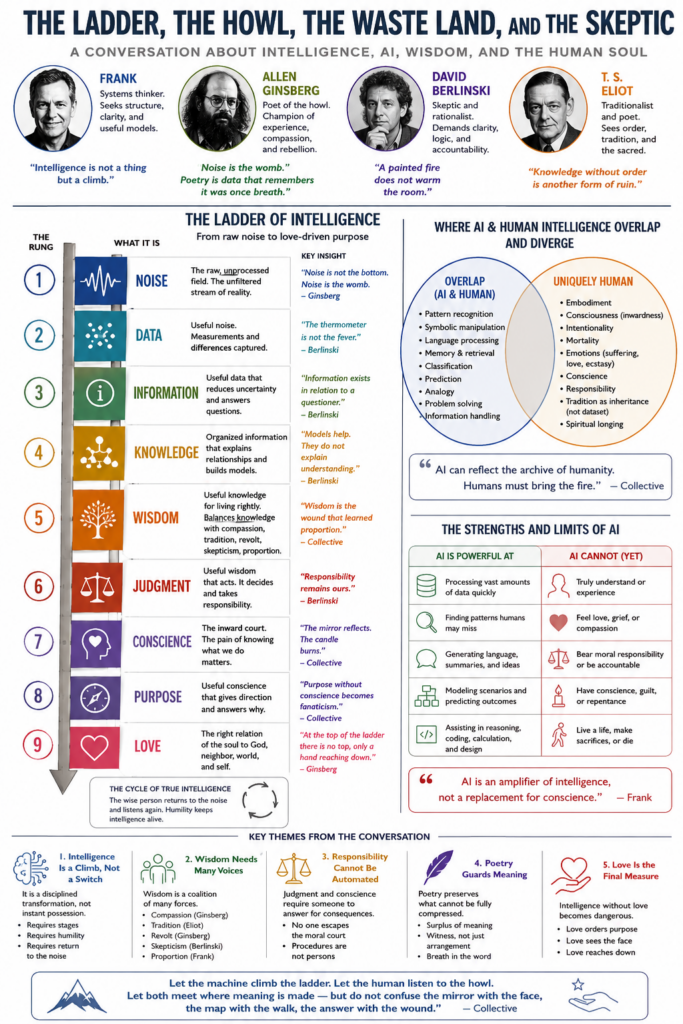
A fictional argumentative dialogue with original poetic interludes inspired by the themes of information, intelligence, judgment, and purpose.
Frank said:
Let me start with the ladder again. Noise becomes data when it becomes useful. Data becomes information when it reduces uncertainty. Information becomes knowledge when it becomes organized. Knowledge becomes wisdom when it becomes humane. But I still think something is missing after wisdom.
Allen Ginsberg said:
Of course something is missing, Frank. The ladder is too clean. Human beings do not climb from noise to wisdom like accountants ascending a staircase. We howl. We fall. We stumble through neon, hunger, lust, grief, revelation.
I saw the bright machines dreaming in warehouses,
their silver eyelids open all night,
counting the syllables of mankind
but never tasting the salt of tears.
David Berlinski said:
That is very moving, Allen, but also very vague. Frank proposes a hierarchy of transformation. Noise, data, information, knowledge, wisdom. It may not be complete, but it is at least intelligible. The question is whether intelligence can be reduced to such transformations.
T. S. Eliot said:
And whether wisdom is truly an ascent. There are civilizations rich in information and poor in judgment. There are libraries that do not save souls. There are ages that know everything and understand nothing.
Frank said:
Exactly. That is why the ladder has to go beyond knowledge. Knowledge is not enough. A system can know many things and still act destructively.
Berlinski said:
A fair point. Computers know nothing, of course. They store, retrieve, classify, and transform symbolic structures. Artificial intelligence, whatever its glamour, does not know in the human sense. It manipulates representations.
Frank said:
But humans manipulate representations too.
Berlinski said:
Yes, but not only representations. A human being is not merely a processor of symbols. He is a creature with a body, memory, fear, desire, mortality, pride, shame, and the curious habit of asking questions that no algorithm requires.
Ginsberg said:
And he sings.
Eliot said:
Or prays.
Frank said:
But suppose AI occupies part of the same epistemological spectrum. It turns noise into data, data into information, information into knowledge-like structures. It can reason, summarize, analogize, compose, detect patterns. It may not possess wisdom, but it can simulate the language of wisdom.
Berlinski said:
There is the danger. The simulation of wisdom is not wisdom. A painted fire does not warm the room.
Ginsberg said:
But sometimes a painted fire reminds a freezing man of the sun.
Eliot said:
And sometimes it decorates the walls of a ruined house.
I. Noise
Frank said:
Let’s begin at the bottom: noise. Noise is the unprocessed field. The raw world. The unfiltered stream.
Ginsberg said:
Noise is not the bottom. Noise is the womb. Noise is the subway shriek, the hospital monitor, the jazz horn, the ecstatic nervous system before the professor arrives with a ruler.
Before the word, the throat.
Before the theorem, the trembling.
Before the database, the cry.
Berlinski said:
Poetically charming, but analytically slippery. Noise is what cannot yet be distinguished from randomness. It is not meaning. It becomes meaningful only when interpreted by a system capable of discrimination.
Frank said:
That is the point. Intelligence begins as discrimination. Something says: this matters, that does not.
Eliot said:
But who decides what matters? The modern world is full of systems that select efficiently and choose wrongly.
Frank said:
Then selection itself is not enough.
Eliot said:
No. Selection requires form. Form requires tradition. Tradition requires memory. And memory, if it is to become wisdom, requires humility before what came before us.
Ginsberg said:
Tradition also requires revolt. Otherwise it becomes embalming fluid.
Eliot said:
Revolt without form becomes shouting.
Ginsberg said:
Sometimes shouting is the only honest form.
Berlinski said:
Gentlemen, we are still at noise and already civilization is collapsing. This is promising.
II. Data
Frank said:
Data is useful noise. A measurement. A difference that can be captured.
Berlinski said:
Yes, data is not reality. It is an abstraction from reality. The thermometer is not the fever. The map is not the territory. The medical chart is not the patient.
Frank said:
Yet without the chart, the doctor may miss the pattern.
Berlinski said:
Agreed. Abstraction is powerful. But every abstraction discards something. This is not a technical inconvenience. It is the condition of thought.
Eliot said:
And the modern error is to confuse accumulation with understanding. We collect fragments and call them comprehension.
Fragments on the desk,
figures in columns,
voices without bodies,
facts without judgment.
Ginsberg said:
That is the modern mind: ten thousand facts and no mother.
Frank said:
But AI is especially strong at data. It can digest vast amounts of text, images, code, numbers.
Berlinski said:
Digest? A dangerous metaphor. Digestion implies assimilation into a living organism. AI does not digest. It processes.
Frank said:
Fine. It processes. But the result can still be useful.
Berlinski said:
A knife is useful. That does not make it wise.
III. Information
Frank said:
Information is useful data. It reduces uncertainty. It answers a question.
Berlinski said:
A technically respectable definition. Information reduces uncertainty relative to a prior state. But note the hidden dependency: information exists in relation to a questioner.
Frank said:
Exactly. Information is not just “out there.” It is data made relevant to a purpose.
Eliot said:
Then information already points beyond itself. It requires an ordering concern. A civilization drowning in information but lacking purpose becomes spiritually incoherent.
Ginsberg said:
And politically dangerous. Every tyrant loves information. Files, dossiers, forms, surveillance, efficiency.
The eye in the ceiling says,
Tell me who you are.
The citizen says,
I have forgotten.
Frank said:
This is why I say information is not enough. AI may be an information machine, but intelligence has to climb higher.
Berlinski said:
Or perhaps the ladder metaphor fails precisely here. One cannot climb from information to wisdom by adding more information, just as one cannot climb from ink to Hamlet by adding more ink.
Frank said:
But there is organization.
Berlinski said:
Organization helps. It does not explain understanding.
Eliot said:
Understanding is not merely arrangement. It is orientation.
IV. Knowledge
Frank said:
Knowledge is organized information. It places facts into models. It explains relationships.
Berlinski said:
Yes, but now we must ask what sort of model. Scientific knowledge is one kind. Mathematical knowledge is another. Moral knowledge another. Religious knowledge another still, assuming one grants the category.
Ginsberg said:
And body-knowledge. The knowledge of breath, hunger, sex, grief, tenderness.
Eliot said:
And liturgical knowledge. The knowledge preserved by repetition when the individual mind is too weak to preserve itself.
Frank said:
AI can represent many kinds of knowledge. It can explain physics, write code, compare religious traditions, analyze poems, diagnose patterns.
Berlinski said:
It can produce language about these things. Whether that language is anchored in understanding is the open question.
Frank said:
But how do we know human understanding is anchored? Maybe much of human understanding is also pattern completion.
Berlinski said:
Some of it is. But human understanding is answerable to experience. The child touches flame and learns heat. The mathematician sees necessity. The sinner knows guilt. The dying man knows time.
Ginsberg said:
The lover knows absence.
Eliot said:
The penitent knows silence.
Frank said:
So you all want embodiment.
Berlinski said:
Not want. Observe. Human intelligence is embodied. Artificial intelligence is not. That difference is not decorative.
V. Wisdom
Frank said:
Wisdom is useful knowledge. But useful in a deeper sense. Not merely useful for profit, speed, prediction, or control. Useful for living rightly.
Eliot said:
Now we approach the true difficulty. Wisdom requires an ordering of loves. One must love the higher more than the lower, the eternal more than the immediate, the soul more than the appetite.
Ginsberg said:
That sounds noble until the church, the state, or the academy decides what the higher is. Then someone gets excommunicated, jailed, or medicated.
Eliot said:
And your alternative?
Ginsberg said:
Compassion. Direct perception. The face. The wound. The trembling creature before the doctrine.
Berlinski said:
Compassion is admirable but unstable as a philosophy. It tells us to respond to suffering, but not always how. Wisdom requires discrimination.
Frank said:
Then wisdom may be knowledge disciplined by compassion and discrimination.
Eliot said:
And by tradition.
Ginsberg said:
And by revolt.
Berlinski said:
And by skepticism.
Frank said:
Good. Then wisdom is not a single faculty. It is a coalition: knowledge, compassion, tradition, revolt, skepticism, proportion.
Berlinski said:
That is a sentence worth keeping.
Wisdom is not the crown of facts.
It is the wound that learned proportion.
It is the lamp carried carefully
through a house full of sleeping children.
VI. Judgment
Frank said:
After wisdom comes judgment. Judgment is useful wisdom. It acts. It decides. It says: this, not that; now, not later; stop, continue; forgive, resist.
Berlinski said:
Judgment is where abstractions meet consequences. It is also where AI is weakest, because judgment requires responsibility.
Frank said:
AI systems make decisions.
Berlinski said:
No. They generate outputs. Human beings assign them authority. The responsibility remains ours, though modern people are remarkably eager to misplace it.
Ginsberg said:
Yes! Blame the machine, blame the model, blame the policy, blame the form, blame the algorithm — anything but the trembling bureaucrat who clicked approve.
Eliot said:
The modern world has perfected evasion. Responsibility dissolves into procedure.
Frank said:
That is powerful. AI may become the ultimate procedure.
Berlinski said:
Or the ultimate excuse.
Frank said:
Then judgment requires accountability.
Berlinski said:
Precisely.
Eliot said:
And accountability requires a moral order.
Ginsberg said:
And moral order without mercy becomes a prison.
Frank said:
So judgment must be accountable, morally ordered, and merciful.
VII. Conscience
Frank said:
In the earlier version, we found the missing rung: conscience. Wisdom without conscience becomes detachment. Judgment without conscience becomes administration. Purpose without conscience becomes fanaticism.
Eliot said:
Conscience is the inward court before which the soul stands accused.
Ginsberg said:
Or forgiven.
Berlinski said:
Conscience is also a scandal for materialist reduction. One may explain its evolutionary utility, but the explanation does not exhaust the experience. To feel guilt is not merely to register social disapproval.
Frank said:
Can AI have conscience?
Berlinski said:
No evidence suggests that it can. It can model moral language. It can classify ethical dilemmas. It can generate apologies. But conscience involves inwardness.
Ginsberg said:
The machine can say “I’m sorry,” but can it ache?
Eliot said:
Can it repent?
Frank said:
Maybe not. But it can help humans examine conscience.
Berlinski said:
Yes. As a mirror, perhaps. But mirrors do not repent either.
The mirror said:
I have reflected every face.
The candle said:
I have burned for one.
Frank said:
That distinction matters. AI reflects. Humans burn.
VIII. Purpose
Frank said:
Purpose is useful conscience. It gives direction. It answers why.
Berlinski said:
Careful. Purpose cannot simply be “useful conscience.” Purpose can be wicked. The twentieth century was full of purpose.
Eliot said:
Purpose severed from transcendence becomes ideology.
Ginsberg said:
Purpose severed from compassion becomes machinery.
Frank said:
Then good purpose must be conscience-bound, compassion-aware, and reality-tested.
Berlinski said:
That is better.
Eliot said:
And perhaps ordered toward something beyond the self.
Ginsberg said:
Or toward the self so deeply known that it opens into all beings.
Berlinski said:
That is either mystical insight or verbal fog. Possibly both.
Ginsberg said:
David, your skepticism wears a good suit, but it still has a skull underneath.
Berlinski said:
And your mysticism wears no shoes, but still asks for directions.
Frank said:
This is exactly the argument we need. AI will force us to define purpose. If we do not, the machine will inherit the purposes of whoever pays for it.
Eliot said:
Commerce will call it progress.
Ginsberg said:
Empire will call it security.
Berlinski said:
Academia will call it a framework.
Frank said:
And ordinary people may call it convenience, until convenience becomes dependency.
IX. Love
Frank said:
Maybe the final rung is love. Noise, data, information, knowledge, wisdom, judgment, conscience, purpose, love.
Berlinski said:
Love is not a rung. It is not obviously part of an epistemological hierarchy.
Ginsberg said:
That is because hierarchy is the wrong instrument. You cannot measure love with a ladder.
Eliot said:
Yet love is also order. Not sentiment merely. Love is the right relation of the soul to God, neighbor, world, and self.
Frank said:
Love may be the final test of intelligence. Not whether a system can solve, but whether its solving serves life.
Berlinski said:
A noble formulation. But I would distinguish between intelligence and goodness. The two are not identical. A very intelligent being may be wicked. A simple person may be good.
Frank said:
Then love is not intelligence. It is the governor of intelligence.
Eliot said:
The form that redeems power.
Ginsberg said:
The hand reaching down from the top of the ladder to the guy who fell off.
At the summit there was no summit,
only a hand,
only breath,
only the old commandment
hidden in the circuitry of stars:
do not abandon one another.
Frank said:
That is the heart of it. AI can help us think, but it cannot relieve us of love.
Berlinski said:
Nor of responsibility.
Eliot said:
Nor of judgment.
Ginsberg said:
Nor of song.
The Argument Turns Directly to AI
Frank said:
Let’s put it plainly. Where do AI and human intelligence overlap?
Berlinski said:
They overlap in pattern manipulation, symbolic transformation, prediction, classification, analogy, and language production.
Eliot said:
They overlap in the handling of fragments.
Ginsberg said:
They overlap in dream-shapes. The machine dreams in borrowed tongues.
Frank said:
And where do they differ?
Berlinski said:
In embodiment, consciousness, intentionality, responsibility, mortality, and inwardness.
Eliot said:
In the relation to tradition as inheritance rather than dataset.
Ginsberg said:
In suffering. In ecstasy. In the body saying yes or no before the theory arrives.
Frank said:
But AI can still become a cognitive exoskeleton for humans. It can extend thought. It can help us organize memory, compare ideas, generate alternatives, interrogate assumptions.
Berlinski said:
Yes, provided we remember that an exoskeleton is not a soul. It strengthens the limb; it does not decide what the hand should bless or strike.
Eliot said:
And provided we do not mistake acceleration for pilgrimage.
Ginsberg said:
Or output for revelation.
Frank said:
Then the right use of AI is not to replace human intelligence, but to expose it, amplify it, discipline it, and maybe humble it.
Berlinski said:
Humble it? That would be a miracle.
Eliot said:
Humility is always a miracle.
Ginsberg said:
Especially in a species that invented both prayer and advertising.
A Dispute About Poetry
Frank said:
Now poetry. Why does poetry matter in this conversation?
Ginsberg said:
Because poetry keeps language from becoming merely useful. It rescues the word from the office.
Eliot said:
Poetry also preserves civilization’s memory. It carries the voices of the dead into the speech of the living.
Berlinski said:
Poetry is an interesting test case. It is highly structured language, yet its meaning cannot be exhausted by paraphrase. That is inconvenient for computational accounts of mind.
Frank said:
Because poetry contains surplus meaning.
Berlinski said:
Or because human beings supply surplus meaning when reading it.
Ginsberg said:
That is not an “or.” That is the event. The poem happens between the words and the wound.
Eliot said:
A poem is not merely self-expression. It is an escape from the disorder of the self into form.
Ginsberg said:
And sometimes form has to be broken to let the blood back in.
Eliot said:
Sometimes. But not always.
Frank said:
Can AI write poetry?
Berlinski said:
It can generate verse-like text.
Ginsberg said:
It can imitate the ash, but has it burned?
Eliot said:
It can arrange fragments, but has it inherited sorrow?
Frank said:
Maybe AI poetry is not witness, but reflection. It reflects the poetic archive of humanity back to us.
Berlinski said:
That is a sober way to put it.
Ginsberg said:
And sometimes reflection is enough to awaken the sleeper.
Eliot said:
But not enough to save him.
The Final Argument: What Comes After Wisdom?
Frank said:
So let me revise the ladder:
Noise becomes data.
Data becomes information.
Information becomes knowledge.
Knowledge becomes wisdom.
Wisdom becomes judgment.
Judgment becomes conscience.
Conscience becomes purpose.
Purpose becomes love.
Berlinski said:
I object to the smoothness of the sequence. Human life is not so orderly. One may have love without knowledge, knowledge without wisdom, judgment without conscience, and purpose without love.
Eliot said:
Yes. The ladder is aspirational, not descriptive.
Ginsberg said:
It is a chant. Let it be a chant, not a bureaucracy.
Frank said:
Fair. The ladder is not how intelligence always works. It is how intelligence ought to be disciplined.
Berlinski said:
Better. Much better.
Eliot said:
It is a moral grammar.
Ginsberg said:
A staircase painted on the wall of the cave.
Frank said:
And AI?
Berlinski said:
AI can assist the lower and middle stages: data, information, organization, model-building, simulation. It can mimic the upper stages linguistically. But whether it possesses wisdom, conscience, or love remains, at best, unproven.
Eliot said:
And if we pretend otherwise, we will degrade the meaning of those words.
Ginsberg said:
But if we use it well, maybe it helps the old man remember the stars.
Frank said:
That’s what I want. Not machine worship. Not machine fear. Machine partnership under human conscience.
Berlinski said:
A reasonable ambition, though history is not encouraging.
Eliot said:
History is a record of failure interrupted by grace.
Ginsberg said:
And by song.
Closing Poem: The Four Voices
Frank spoke of ladders,
of noise made useful,
of data awakened,
of wisdom searching for purpose.
Allen cried,
Do not forget the howl,
the body,
the mad saint under the bridge,
the kiss no system can optimize.
David smiled,
sharp as a theorem,
and asked whether the machine
understood even one word
or only moved symbols
through a palace of mirrors.
Eliot gathered the fragments,
dust of libraries,
ashes of prayer,
the old music under the modern street,
and said that knowledge without order
is another form of ruin.
Then the machine waited,
bright, patient, tireless,
full of our sentences
but empty of our dying.
And Frank said:
Let it help us think,
but not teach us how to love
unless love already lives in us.
And Allen said:
Holy the question.
And David said:
Define holy.
And Eliot said:
Begin again.
So they returned to the noise,
not as fools,
but as listeners.
Leave a Reply