|
Getting your Trinity Audio player ready…
|
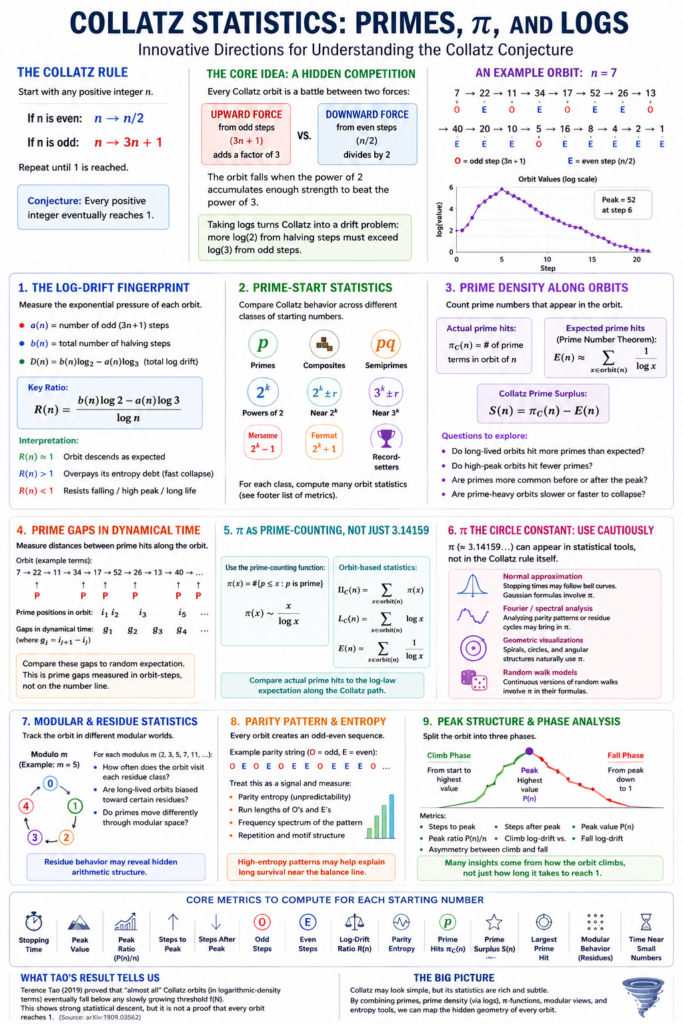
Here is a real example of #1: The Log-Drift Fingerprint, using the orbit that starts at n = 7.
R(n)=\frac{b(n)\log 2-a(n)\log 3}{\log n}
Collatz orbit for n = 7
7 → 22 → 11 → 34 → 17 → 52 → 26 → 13 → 40 → 20 → 10 → 5 → 16 → 8 → 4 → 2 → 1
Now count the two competing forces:
Odd steps, where we apply 3n + 1:
7 → 2211 → 3417 → 5213 → 405 → 16
So:
a(n) = 5 odd steps
Even steps, where we apply n / 2:
22 → 1134 → 1752 → 2626 → 1340 → 2020 → 1010 → 516 → 88 → 44 → 22 → 1
So:
b(n) = 11 halving steps
Now compute the log-drift:
11 log(2) − 5 log(3)
Using natural logs:
11 × 0.6931 − 5 × 1.0986
= 7.6241 − 5.4930
= 2.1311
Now divide by log(7):
R(7) = 2.1311 / 1.9459
R(7) ≈ 1.095
Interpretation
For n = 7, the log-drift ratio is:
R(7) ≈ 1.095
That means the orbit had slightly more downward halving pressure than was minimally needed to erase the upward pressure from the odd 3n + 1 steps.
In plain English:
The number 7 rises to 52, but the orbit eventually “overpays” its entropy debt with enough divisions by 2 to collapse to 1.
A ratio near 1 means the orbit descends in a fairly expected way. A ratio much above 1 means it falls efficiently. A ratio below 1, especially for a long stretch, would signal a stubborn orbit that resists collapse and may climb high before finally falling.
For n = 7, the Collatz path is:
7 rises up to 52, then falls down to 1.
The “log-drift fingerprint” is just a way of asking:
Did the downward steps beat the upward steps strongly enough?
In the Collatz rule, two things happen:
When the number is odd, it gets pushed upward:
7 becomes 22
That is the “up force.”
When the number is even, it gets cut in half:
22 becomes 11
That is the “down force.”
For the number 7, there are:
5 upward odd moves
and
11 downward halving moves
So even though 7 climbs as high as 52, it gets cut in half often enough afterward that the downward pressure wins.
The final score is about:
1.095
In plain English, that means:
7 had a little more falling power than rising power.
Not a huge amount. Just enough.
So the story of 7 is:
It climbs, peaks at 52, then the repeated halvings overpower the climbs and pull it down to 1.
That is what #1 is measuring:
the tug-of-war between climb and collapse.
Leave a Reply