|
Getting your Trinity Audio player ready…
|
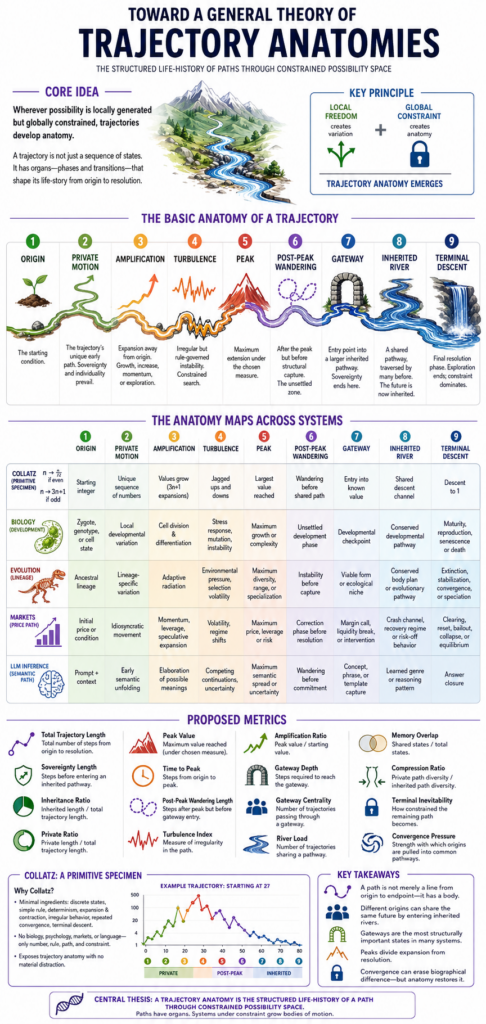
Definitions, Axioms, Metrics, and the Collatz Case as a Primitive Specimen
Abstract
This paper proposes a general theory of trajectory anatomies: the structured internal life-history of paths generated by rule-bound systems moving through constrained possibility spaces. The theory begins with the Collatz process as a minimal mathematical specimen, but does not treat Collatz as a metaphor for biology, markets, evolution, or language models. Instead, Collatz is treated as a stripped-down case in which trajectory anatomy becomes visible with unusual clarity.
The central claim is that a trajectory is not merely a sequence of states. Under certain conditions, a trajectory develops identifiable regions: origin, private motion, amplification, turbulence, peak, post-peak wandering, gateway, inherited river, and terminal descent. These regions can be named, measured, and compared across systems.
The proposed theory is structural rather than material. It does not claim that Collatz, biology, markets, LLMs, and evolution are the same kind of system. It claims that systems governed by local transformation rules and global constraints may produce homologous trajectory organs.
The core thesis is:
Wherever possibility is locally generated but globally constrained, trajectories develop anatomy.
1. Introduction
Many systems are studied through their rules, their endpoints, or their statistical averages. But this often neglects the internal structure of the paths themselves.
In the Collatz process, for example, the classical question is whether every positive integer eventually reaches 1 under the rule:
- if n is even, divide by 2;
- if n is odd, compute 3n + 1.
The usual emphasis is terminal: does the trajectory reach 1?
But the trajectory contains far more information than its endpoint. Some inputs rise dramatically before falling. Some wander. Some quickly enter common pathways. Some remain private for longer. Some hit frequently shared gateway values. Some join ancient descent channels traversed by many previous inputs.
This suggests that the path itself has structure.
This paper proposes that such structure can be understood as trajectory anatomy.
A trajectory anatomy is not a metaphor imposed from outside. It is the structured life-history revealed by the path as it moves through a constrained transformation system.
2. Core Definition
Definition 1: Trajectory
A trajectory is an ordered sequence of states generated by repeatedly applying a transformation rule to an initial condition.
Formally:
T(x₀) = {x₀, x₁, x₂, …, xₙ}
where each subsequent state is produced by some rule R:
xᵢ₊₁ = R(xᵢ)
In Collatz:
R(n) = n / 2 if n is even
R(n) = 3n + 1 if n is odd
Definition 2: Trajectory Anatomy
A trajectory anatomy is the structured internal organization of a trajectory, including its phases, thresholds, extremal points, convergence zones, inheritance events, and terminal resolution.
In plain English:
A trajectory anatomy is the body plan of a path.
It asks not merely where a path begins or ends, but how it lives between origin and resolution.
Definition 3: Constrained Possibility Space
A constrained possibility space is the set of all states a system may enter under its rules, together with the restrictions imposed by those rules.
A system must have both possibility and constraint.
If there is only constraint, the path is trivial.
If there is only possibility, the path is noise.
Trajectory anatomy emerges when both coexist.
3. The Basic Anatomical Sequence
A generalized trajectory anatomy may be described as:
origin → private motion → amplification → turbulence → peak → post-peak wandering → gateway → inherited river → terminal descent
More abstractly:
individuality → exploration → expansion → instability → extremum → search → capture → inheritance → resolution
These stages do not need to appear equally in every system. Some may be brief, hidden, repeated, or absent. But the theory proposes that many constrained systems generate recognizable versions of these regions.
4. Anatomical Definitions
4.1 Origin
The origin is the initial condition from which the trajectory begins.
In Collatz, this is the starting integer.
In biology, it may be a genotype, embryo, cell state, or organism.
In markets, it may be an initial price, liquidity state, leverage condition, or balance-sheet configuration.
In an LLM, it may be the prompt plus context.
The origin matters, but the full future of the trajectory is not usually readable from the origin alone.
4.2 Private Motion
Private motion is the portion of a trajectory that remains unique or relatively unshared.
In Collatz, this is the early part of the path before the input merges with a pathway already traversed by other inputs.
Private motion is the zone of sovereignty.
It is where the trajectory still appears to possess its own fate.
4.3 Amplification
Amplification is the phase in which a trajectory expands away from its origin or increases in magnitude, complexity, uncertainty, risk, semantic spread, energy, or instability.
In Collatz, amplification often appears as ascent to larger numbers.
In markets, it may appear as momentum, leverage, speculation, or bubble expansion.
In biology, it may appear as growth, mutation, differentiation, or ecological expansion.
In LLMs, it may appear as semantic elaboration.
4.4 Turbulence
Turbulence is irregular but rule-governed motion.
It is not mere randomness. It is the instability produced by the system’s own rules interacting with constraint.
In Collatz, turbulence appears in the jagged alternation between odd expansions and even compressions.
In other systems, turbulence may appear as volatility, developmental instability, immune response, mutation pressure, unstable reasoning, or regime transition.
4.5 Peak
The peak is the maximum extension of the trajectory under a chosen measure.
In Collatz, the peak is often the largest value reached.
In a generalized system, peak may mean:
- maximum magnitude
- maximum energy
- maximum uncertainty
- maximum complexity
- maximum price
- maximum semantic spread
- maximum distance from equilibrium
- maximum risk
- maximum instability
The peak divides the trajectory into pre-peak expansion and post-peak resolution dynamics.
4.6 Post-Peak Wandering
Post-peak wandering is the region after maximum extension but before stable capture into an inherited pathway or terminal regime.
The system has stopped expanding in the relevant sense, but it has not yet resolved.
This may be one of the most important regions in complex systems.
It is the zone between maximum possibility and structural capture.
4.7 Gateway
A gateway is a state or region through which a trajectory enters a larger inherited pathway.
The gateway is the transition from private history to shared history.
In Collatz, a gateway may be a value that many trajectories eventually hit before entering a common descent channel.
In biology, a gateway may be a developmental checkpoint, conserved body-plan transition, or niche constraint.
In markets, a gateway may be a margin threshold, liquidity break, support/resistance level, policy intervention, or panic trigger.
In LLMs, a gateway may be a phrase, template, concept, genre, or reasoning pattern that captures the continuation.
4.8 Inherited River
An inherited river is a shared pathway entered by many trajectories.
Once a trajectory enters an inherited river, its future is no longer private. It continues moving, but it now follows a path older than itself.
This produces a crucial principle:
A trajectory does not only inherit its origin.
It can inherit its future by entering an already-existing path.
4.9 Terminal Descent
Terminal descent is the final resolution phase of a trajectory.
In Collatz, terminal descent is the final approach to 1.
In other systems, terminal descent may mean equilibrium, homeostasis, collapse, extinction, stabilization, reproduction, answer closure, market clearing, or reset.
Terminal descent is the phase in which exploration has largely ended and constraint dominates.
5. Axioms of Trajectory Anatomy
Axiom 1: The Path Is an Object of Study
A trajectory is not reducible to its origin, endpoint, rule, or average behavior.
The path itself contains structure.
Axiom 2: Rule Simplicity Does Not Imply Trajectory Simplicity
A simple rule can produce a path with complex internal anatomy.
Collatz is the primitive example.
The rule is simple.
The trajectories are not.
Axiom 3: Local Freedom and Global Constraint Generate Anatomy
Trajectory anatomy emerges when a system has enough freedom to vary locally but enough constraint to produce recurrent structure.
In compressed form:
Local freedom creates variation.
Global constraint creates anatomy.
Axiom 4: Sovereignty Is Often Temporary
Many trajectories begin with private motion but eventually enter shared structure.
This produces a measurable event:
the loss of sovereignty.
A trajectory loses sovereignty when its future becomes substantially inherited from a pre-existing pathway.
Axiom 5: Inheritance Can Occur Mid-Trajectory
Inheritance is not only an initial condition.
A trajectory may inherit structure after it begins.
This occurs when it enters an inherited river, attractor basin, template, pathway, channel, or regime.
Axiom 6: Convergence Erases Biographical Difference
Two trajectories may share an endpoint while having radically different anatomies.
Therefore, endpoint convergence is not enough.
A theory of trajectory anatomy asks:
How did the trajectories lose their difference?
Axiom 7: Gateways Control the Transfer from Private to Shared Motion
Gateways are structurally important because they mediate entry into inherited pathways.
A system’s most important states may not be its endpoints, but its gateways.
Axiom 8: Peaks Divide Expansion from Resolution
The peak marks the maximum extension of the trajectory under some chosen measure.
After the peak, the trajectory may still wander, but it has passed its maximum expansion.
Axiom 9: Turbulence May Be Rule-Governed Search
Irregularity within a trajectory should not automatically be treated as noise.
Turbulence may be the visible form of constrained search.
Axiom 10: Anatomy Is Discovered, Not Imposed
The anatomical labels are useful only if they correspond to measurable transitions or structural regions in the trajectory.
Poetry may name the structure.
Measurement must discipline it.
6. Proposed Metrics
A formal theory of trajectory anatomies requires measurable quantities.
The following metrics are proposed as a first framework.
6.1 Total Trajectory Length
The total number of steps from origin to terminal resolution.
In Collatz:
total steps from n to 1
This is useful but incomplete. It tells us how long the path is, but not how the path is organized.
6.2 Sovereignty Length
The number of steps during which a trajectory remains private before entering a previously known or shared pathway.
This is one of the central metrics.
Sovereignty length = steps before inherited pathway entry
A long sovereignty length indicates prolonged individuality.
A short sovereignty length indicates rapid capture.
6.3 Inheritance Ratio
The proportion of the trajectory that is inherited rather than private.
inheritance ratio = inherited length / total trajectory length
A high inheritance ratio means most of the trajectory is borrowed from shared structure.
A low inheritance ratio means the trajectory remains private for much of its life.
6.4 Private Ratio
The complement of inheritance ratio.
private ratio = private length / total trajectory length
This measures how much of the path belongs uniquely to the origin.
6.5 Peak Value
The maximum value reached by the trajectory under a selected measure.
In Collatz, this is usually the largest integer reached.
In other systems, peak value may be maximum risk, maximum energy, maximum price, maximum entropy, maximum semantic spread, or maximum deviation.
6.6 Time to Peak
The number of steps from origin to peak.
time to peak = index of peak state – index of origin
This measures how long the trajectory spends in expansion before reaching maximum extension.
6.7 Post-Peak Wandering Length
The number of steps after the peak but before gateway entry or terminal descent.
post-peak wandering length = gateway index – peak index
This captures the unsettled zone between maximum expansion and structural capture.
6.8 Turbulence Index
A measure of irregularity in the trajectory.
Possible versions include:
- number of directional reversals
- variance in step-to-step change
- ratio of expansions to contractions
- volatility of magnitude
- entropy of transition types
- local jaggedness of the path
In Collatz, a simple turbulence index might count alternations between upward and downward moves before the peak or before gateway entry.
6.9 Amplification Ratio
A measure of how far the trajectory expands relative to origin.
In Collatz:
amplification ratio = peak value / starting value
This reveals whether the trajectory grows modestly or explosively before resolving.
6.10 Gateway Depth
The number of steps required to reach the gateway into inherited structure.
gateway depth = index of first gateway state
This measures how deeply into its private biography the trajectory travels before capture.
6.11 Gateway Centrality
The number of trajectories that pass through a given gateway.
gateway centrality = count of trajectories using gateway G
High-centrality gateways are major structural channels in the system.
In the river metaphor, they are major confluences.
6.12 River Load
The number of trajectories sharing a particular inherited pathway.
river load = number of trajectories passing through a shared path segment
This identifies the dominant inherited rivers of the system.
6.13 Memory Overlap
The degree to which a trajectory overlaps with prior trajectories.
Possible formula:
memory overlap = number of shared states / total states
This measures how much of the trajectory is original versus already traversed.
6.14 Compression Ratio
A measure of how much private complexity collapses into shared structure.
One possible definition:
compression ratio = private path diversity / inherited path diversity
In Collatz, many distinct private paths may collapse into a much smaller number of inherited descent channels.
6.15 Terminal Inevitability
A measure of how constrained the remaining path becomes after gateway entry.
In deterministic systems like Collatz, once a trajectory hits a known state, the remainder is fixed.
In probabilistic systems, terminal inevitability may be measured as the probability concentration of future paths after gateway entry.
6.16 Convergence Pressure
A system-level measure of how strongly different origins are pulled into common pathways.
Possible indicators include:
- number of shared gateways
- concentration of river load
- average sovereignty length
- distribution of inheritance ratios
- attractor basin size
High convergence pressure means many different origins are rapidly absorbed into shared structure.
Low convergence pressure means trajectories remain more individualized.
7. The Collatz Process as Primitive Specimen
The Collatz process is valuable because it contains minimal ingredients:
- discrete states
- a simple local rule
- deterministic transformation
- expansion and contraction
- irregular trajectory behavior
- repeated convergence into shared pathways
- terminal descent
It is not useful because it represents everything else.
It is useful because it exposes trajectory anatomy with almost no material distraction.
Collatz has no biology, psychology, money, agents, neurons, chemistry, markets, or language.
It has only number, rule, path, and constraint.
That is why it serves as a primitive specimen.
It is not a metaphor for the river.
It is a river made of arithmetic.
8. Structural Applications Beyond Collatz
The theory should be applied cautiously. The claim is not that all systems are Collatz-like.
The claim is that certain trajectory organs may recur across unlike systems because the abstract conditions are similar.
8.1 Biology
In biological development, an organism begins with genetic, epigenetic, cellular, and environmental individuality.
But development is not unconstrained. It proceeds through conserved pathways, body-plan constraints, biochemical gates, and regulatory checkpoints.
Possible trajectory organs:
- origin: zygote, genotype, or cell state
- private motion: local developmental variation
- amplification: cell division and differentiation
- turbulence: stress response, mutation, regulatory instability
- gateway: developmental checkpoint
- inherited river: conserved developmental pathway
- terminal descent: mature form, reproduction, senescence, or death
8.2 Evolution
In evolution, lineages explore variation through mutation, recombination, selection, drift, and ecological pressure.
But not all forms are viable. The possibility space is constrained by physics, chemistry, development, ecology, and history.
Possible trajectory organs:
- origin: ancestral lineage
- private motion: lineage-specific variation
- amplification: adaptive radiation
- turbulence: environmental instability or selection pressure
- peak: maximum diversity, range, or specialization
- gateway: viable adaptive form or ecological niche
- inherited river: conserved body plan or evolutionary pathway
- terminal descent: extinction, stabilization, convergence, or speciation
8.3 Markets
Markets often appear locally free but are globally constrained by liquidity, leverage, policy, balance sheets, risk appetite, and crowd behavior.
Possible trajectory organs:
- origin: initial price or market condition
- private motion: idiosyncratic movement
- amplification: momentum, leverage, speculative expansion
- turbulence: volatility
- peak: maximum price, leverage, or risk
- post-peak wandering: unstable correction phase
- gateway: margin call, liquidity break, support failure, policy intervention
- inherited river: crash channel, recovery regime, risk-off behavior
- terminal descent: clearing, reset, bailout, collapse, or equilibrium
8.4 LLM Inference
An LLM response begins with a prompt and context. Its continuation is locally generated token by token, but globally constrained by learned weights, attention, context, probability distributions, genre conventions, and instruction hierarchy.
Possible trajectory organs:
- origin: prompt plus context
- private motion: early semantic unfolding
- amplification: elaboration of possible meanings
- turbulence: competing continuations or unstable reasoning
- peak: maximum semantic spread or uncertainty
- gateway: phrase, concept, template, or reasoning frame
- inherited river: learned genre or explanation pattern
- terminal descent: answer closure
In this view, an LLM answer is not merely emitted. It follows a constrained semantic trajectory.
9. Homologous Trajectory Organs
The theory does not require material sameness.
A Collatz gateway, a developmental checkpoint, a market liquidity break, and an LLM template are not the same thing.
But they may occupy similar structural roles.
They may all function as gateways from private motion into inherited structure.
This suggests the idea of homologous trajectory organs.
Definition 4: Homologous Trajectory Organ
A homologous trajectory organ is a structural region in one system that performs a similar trajectory function to a region in another system, despite material differences between the systems.
Examples:
- Collatz private ascent and market leverage expansion
- Collatz gateway and developmental checkpoint
- Collatz inherited river and LLM semantic groove
- Collatz terminal descent and market clearing
- Collatz peak and ecological overshoot
This is not metaphorical sameness.
It is functional similarity within trajectory structure.
10. Central Thesis
The proposed general theory can be compressed into the following statement:
A trajectory anatomy is the structured life-history of a path through constrained possibility space.
The governing principle is:
Wherever possibility is locally generated but globally constrained, trajectories develop anatomy.
The most compact form is:
Paths have organs.
The more poetic form is:
Systems do not merely move. Under constraint, they grow bodies of motion.
11. Implications
A theory of trajectory anatomies shifts attention away from endpoints alone.
It asks:
- How long did the trajectory remain private?
- Where did it amplify?
- Where did it become turbulent?
- Where did it peak?
- How long did it wander after peak?
- Where did it enter shared structure?
- Which gateways dominate the system?
- How much of the path was inherited?
- How did convergence erase difference?
- What anatomical regions did the endpoint conceal?
This is especially important for systems where convergence hides history.
Two paths may end in the same place but possess entirely different biographies.
The endpoint erases difference.
The anatomy restores it.
12. Conclusion
Collatz may not be merely a numerical curiosity, nor merely a metaphor for rivers, markets, biology, LLMs, or evolution.
It may be a primitive specimen of a broader phenomenon.
It shows that even a simple rule can generate trajectories with internal structure: private motion, amplification, turbulence, peak, wandering, gateway, inherited river, and terminal descent.
The broader theory is not that the world is Collatz.
The broader theory is that many systems may produce structured paths when local possibility moves through global constraint.
Collatz is valuable because it exposes the skeleton.
The next task is to determine whether other systems possess homologous trajectory organs — not by analogy alone, but by measurable structure.
The final claim is simple:
A path is not merely a line from origin to endpoint.
A path has a body.
Trajectory anatomy is the study of that body.
Leave a Reply