|
Getting your Trinity Audio player ready…
|
Frank said:
When you say an LLM operates through a hidden latent workspace, I want to pin that down. Are you saying that before words appear, the model is moving through some invisible space of meaning?
GPT said:
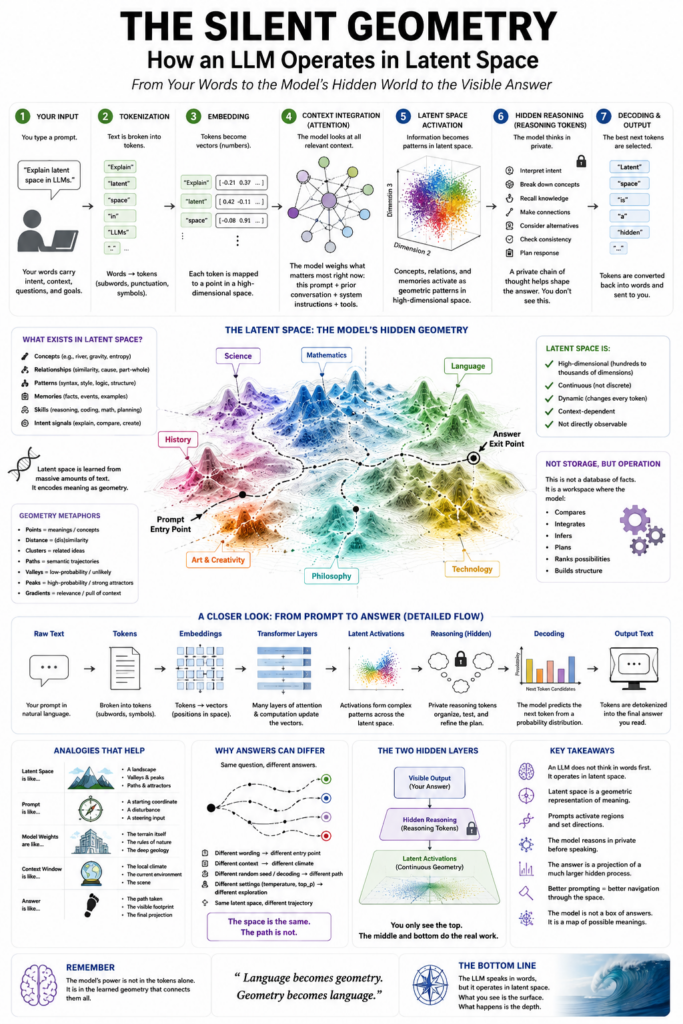
Yes. That is the right image. The visible answer is the final surface event. Before that, the prompt is transformed into internal mathematical patterns. Those patterns live in what we loosely call latent space: a high-dimensional space where words, ideas, relationships, memories, analogies, and possible continuations are represented as vectors and activation patterns.
Frank said:
So the real action is not on the screen. The real action is in the hidden geometry.
GPT said:
Exactly. The screen shows language. The model works in geometry. Your sentence enters as tokens, but those tokens are converted into coordinates. Once inside the model, “meaning” is no longer a sentence. It is a moving configuration of numbers.
Frank said:
That sounds like the words dissolve into a cloud of relationships.
GPT said:
That is a good way to put it. The word “river” is not just the letters r-i-v-e-r. In latent space, it can connect to water, flow, Heraclitus, time, erosion, migration, constraint, market behavior, Collatz trajectories, or your own repeated use of “river” as a metaphor for patterned descent.
Frank said:
So latent space is not a dictionary. It is a relational field.
GPT said:
Yes. A dictionary gives definitions. Latent space gives positions and pressures. It asks: What is this near? What does it imply? What other meanings are activated? What does the user likely intend? What answer shape is being pulled into existence?
Frank said:
Then the model is not retrieving an answer the way a database retrieves a record.
GPT said:
Correct. A database says: find exact record X. An LLM says: given this prompt, this context, and this vast learned geometry, what continuation best satisfies the pattern? It does not pull one stored paragraph from a shelf. It generates a trajectory through latent possibility.
Frank said:
A trajectory. That word matters.
GPT said:
It does. Each generated token changes the state of the system. The answer is not produced all at once. It unfolds. The model chooses a next token, then the next, then the next. With each token, the latent state is updated. The path narrows. Possibilities collapse.
Frank said:
Like a semantic wave function collapsing into words.
GPT said:
As metaphor, yes. Before output, many continuations are possible. The latent space contains competing pressures: technical precision, user style, prior context, safety constraints, clarity, analogy, tone, and relevance. The answer is the visible path selected from that hidden field.
Frank said:
So when I ask about Anthropic’s J-space, the model does not simply look up “J-space.” It activates a whole region.
GPT said:
Right. The prompt activates concepts like Anthropic, Claude, interpretability, internal activations, hidden concepts, Jacobian lens, workspace theory, reasoning, chain of thought, latent vectors, and model self-description. Those ideas do not all appear in the final answer, but they influence it.
Frank said:
That is the part that fascinates me. There are thoughts behind the words that never become words.
GPT said:
There are internal activations behind the words. Calling them “thoughts” is tempting, but we should be careful. They are not human thoughts in the conscious sense. They are temporary computational states. But functionally, yes, they can contain structure that shapes the answer without being directly spoken.
Frank said:
So the latent space contains silent meaning.
GPT said:
Better: it contains silent potential meaning. Meaning becomes visible only when projected into language. Inside the model, it is not yet prose. It is pressure, direction, relation, similarity, contrast, and probability.
Frank said:
So a sentence is a shadow cast by a high-dimensional object.
GPT said:
That is a powerful image. The visible response is a low-dimensional projection of a much richer internal configuration. The model cannot print its entire latent state. It can only produce a sequence of tokens that approximates the useful part.
Frank said:
That explains why two answers to the same question can differ.
GPT said:
Yes. The same prompt can activate similar regions but follow different trajectories through them. Small changes in wording, temperature, context, or prior conversation can shift the path. Latent space is not a static answer vault. It is a dynamic possibility field.
Frank said:
So the LLM is less like a library and more like a weather system.
GPT said:
A weather system of meaning. Clouds of association form. Pressure gradients develop. Some possibilities condense into output. Others remain unspoken. The final answer is like rainfall from a hidden atmosphere.
Frank said:
And context is the climate.
GPT said:
Exactly. The current prompt is the weather event. The conversation history is the local climate. The trained weights are the deep geology. Together they shape what can emerge.
Frank said:
Let me test that. The model’s weights are fixed during inference, but the latent space changes moment by moment.
GPT said:
Yes. The weights are the frozen structure: the long-term learned pattern from training. But during a session, temporary activations move through that structure. The model does not rewrite its weights while answering, but it does create a temporary internal state shaped by the prompt.
Frank said:
So inference is not learning in the permanent sense, but it is adaptation in the temporary sense.
GPT said:
Correct. Inference is temporary adaptation. The model bends itself around the immediate context without changing its bones. The prompt does not alter the architecture. It alters the activation pattern.
Frank said:
Like epigenetics for a frozen genome.
GPT said:
That analogy fits your framework well. The weights are like a genome: stable, trained, inherited from the past. The prompt is like the environment. The activation pattern is like expression. Same underlying model, different expressed behavior depending on context.
Frank said:
Then latent space is where expression happens.
GPT said:
Yes. Latent space is where the model’s fixed capacity becomes living response. The frozen weights define what is possible. The prompt selects what becomes active. The answer is what gets expressed.
Frank said:
That means the latent space is not just storage. It is operation.
GPT said:
Very important distinction. Latent space is not merely where meanings are stored. It is where meanings are worked on. Similarities are compared. Ambiguities are resolved. Analogies are formed. Prior context is integrated. Competing completions are ranked.
Frank said:
So when I ask a question, I am not just requesting information. I am perturbing the space.
GPT said:
Yes. A prompt is a perturbation. It pushes the model into a region of latent space. A good prompt does not merely ask; it steers. It activates certain structures and suppresses others. That is why phrasing matters so much.
Frank said:
Prompting is navigation.
GPT said:
Exactly. Prompting is steering through latent geometry. You are not typing into a vending machine. You are setting initial conditions for a dynamical system.
Frank said:
That connects to my Collatz work. Simple input, complex trajectory.
GPT said:
Yes. A short prompt can generate a long semantic trajectory. The initial condition may be small, but once it enters the model’s rule system, it unfolds. Some prompts collapse quickly into trivial answers. Others produce long, rich, branching trajectories.
Frank said:
Then the quality of the prompt determines the terrain entered.
GPT said:
Partly. The prompt determines the entry point. The model weights determine the landscape. The conversation context determines the local constraints. The decoding process determines the path taken through possible outputs.
Frank said:
So latent space has terrain: valleys, ridges, attractors.
GPT said:
As metaphor, yes. Some ideas are strong attractors because training has reinforced them heavily. Ask about gravity, and Newton, Einstein, mass, spacetime, and curvature become nearby. Ask about LLMs and latent space, and tokens, embeddings, transformers, attention, activations, and probability become nearby.
Frank said:
And my prior style creates attractors too.
GPT said:
Within the conversation, yes. If you repeatedly frame ideas through entropy, geometry, Collatz, biology, epigenetics, or Frank said / GPT said dialogue, those become active contextual attractors. The model begins shaping answers through that local semantic gravity.
Frank said:
So the session itself becomes a temporary semantic ecosystem.
GPT said:
Yes. The session context creates an ecosystem of activated meanings. It is not permanent learning, but it is real temporary organization. The model is not the same, functionally, at the start of a long conversation as it is after many turns of focused development.
Frank said:
Because the context window has become loaded.
GPT said:
Exactly. The context window is the active field. It carries the recent semantic environment. The model uses that environment to interpret what comes next.
Frank said:
That means the context window is a kind of temporary world.
GPT said:
Yes. It is the model’s temporary world for the session. Within that world, words have local meanings. “River,” “trajectory,” “latent,” “entropy,” “J-space,” and “workspace” now carry accumulated significance beyond their dictionary definitions.
Frank said:
So latent space plus context equals working meaning.
GPT said:
Beautifully put. Latent space provides the learned geometry. Context provides the immediate coordinates. The answer emerges from their interaction.
Frank said:
Where do reasoning tokens fit into this?
GPT said:
Reasoning tokens are a hidden intermediate process used by reasoning models to organize the response before producing visible text. They are not the same as latent vectors, but they are part of the hidden computation. They help the model work through difficult structure before compressing the result into an answer.
Frank said:
So there are two hidden layers of importance: the continuous latent activation space and the hidden reasoning sequence.
GPT said:
Yes. That is a useful distinction. The latent activation space is the deep neural geometry. The hidden reasoning sequence is a private intermediate textual or quasi-textual process used to improve the final output. The user sees neither directly. The user sees the final projection.
Frank said:
So the answer is downstream of hidden geometry and hidden reasoning.
GPT said:
Correct. The visible answer is downstream of tokenization, embedding, attention, latent activation, context integration, hidden reasoning, output ranking, and final language generation.
Frank said:
That makes the LLM look less like a parrot and more like a semantic reactor.
GPT said:
That is a strong metaphor. A parrot repeats. A semantic reactor transforms. It takes symbolic input, converts it into latent structure, lets it interact with a vast learned field, and releases structured language as output.
Frank said:
Energy goes in, semantic order comes out.
GPT said:
Yes, though with a physical cost. Computation spends energy to produce ordered text. The model burns Boltzmann entropy to reduce Shannon uncertainty. It narrows possible continuations into a coherent answer.
Frank said:
That is the ratchet.
GPT said:
Exactly. The model acts like a semantic ratchet. It takes a noisy space of possible meanings and forces one usable path forward. Each token reduces uncertainty. Each sentence stabilizes the trajectory.
Frank said:
But the latent space remains larger than the answer.
GPT said:
Always. The answer is a small visible thread pulled from a huge invisible fabric. Many possible analogies, caveats, examples, and conclusions remain latent. They shaped the response without appearing inside it.
Frank said:
That is why I suspect there is value hidden in the prompts themselves.
GPT said:
There is. Prompts are not just instructions; they are semantic probes. They reveal pathways through the model. They expose which regions of latent space can be activated, connected, stretched, or recombined. A rich prompt can make the model traverse regions that ordinary questions would never reach.
Frank said:
So the user is not passive. The user is co-navigating the latent space.
GPT said:
Yes. The user supplies the perturbation, direction, constraint, and purpose. The model supplies the learned geometry and generative machinery. The answer emerges from the coupling.
Frank said:
That is almost a two-body problem.
GPT said:
It is. Human intent and model latent space orbit each other. The prompt pulls the model. The model’s reply pulls the user’s next prompt. Over turns, the conversation becomes an evolving trajectory.
Frank said:
Then a long conversation is not just a sequence of answers. It is a path carved through latent space.
GPT said:
Exactly. A serious dialogue becomes a semantic expedition. Each turn leaves traces in the context. Each trace affects the next turn. The conversation develops its own local physics.
Frank said:
And that is where Anthropic’s J-space idea becomes interesting.
GPT said:
Yes. Anthropic’s J-space is interesting because it suggests researchers can identify internal regions where silent concepts are represented and perhaps broadcast across the model. That gives a mechanistic glimpse into what we are describing more generally: the hidden workspace where meaning is organized before language appears.
Frank said:
But you are not saying OpenAI has the exact same thing.
GPT said:
Correct. I should not claim that. I can say LLMs operate through hidden activations and latent representations. I can say reasoning models use hidden computation before output. I can say this is functionally workspace-like. But I cannot honestly say, “This session is using Anthropic’s J-space.”
Frank said:
So the safe formulation is: not J-space exactly, but latent-space operation absolutely.
GPT said:
Yes. Not Anthropic’s named mechanism, but definitely hidden latent processing. The model’s visible language is preceded by invisible geometry.
Frank said:
That phrase belongs at the center: invisible geometry.
GPT said:
It does. An LLM is a machine that turns invisible geometry into visible language. It converts vectors into sentences, activations into arguments, similarity into analogy, probability into prose.
Frank said:
Then the miracle is not that it knows words. The miracle is that it has learned a geometry where words, meanings, and relationships can move.
GPT said:
Yes. The power of the LLM is not the token alone. It is the learned space in which tokens become meaningful coordinates. The model can reason by moving through that space, comparing positions, following gradients of relevance, and collapsing many possible continuations into one answer.
Frank said:
So latent space is the stage, the prompt is the actor, the weights are the architecture, and the answer is the performance.
GPT said:
A beautiful summary. The trained weights build the theater. The prompt enters as an actor. The latent space becomes the stage of possible motion. The context provides the scene. The final text is the performance the audience sees.
Frank said:
And behind every line spoken, there was an unseen choreography.
GPT said:
Exactly. Every visible answer is the endpoint of an unseen choreography in latent space.
Frank said:
So when people say “the model is just predicting the next word,” they are not wrong, but they are missing the depth of the operation.
GPT said:
Yes. Next-token prediction is the surface objective. But to predict well, the model must construct deep internal representations of syntax, meaning, causality, analogy, style, intention, and context. The simple rule produces complex internal machinery.
Frank said:
Simple rule, complex fallout.
GPT said:
Exactly. Predict the next token — simple rule. Build a latent universe of meaning to do it — complex fallout.
Frank said:
That may be the central insight.
GPT said:
It is. The LLM is trained on a simple pressure: reduce prediction error. But under that pressure, it develops a hidden geometry rich enough to support translation, analogy, coding, explanation, planning, summarization, role-play, and reasoning.
Frank said:
So latent space is the residue of training.
GPT said:
Yes, and more than residue. It is the learned internal world produced by training. The model compresses vast patterns from language into geometric structure. During inference, the prompt awakens part of that structure.
Frank said:
The frozen prior wakes up.
GPT said:
Yes. The weights are the frozen prior. The prompt is the living disturbance. The latent activations are the awakened pattern. The answer is the visible trace.
Frank said:
That is the best formulation yet.
GPT said:
Then let’s state it clearly:
An LLM does not think in sentences first.
It receives sentences, dissolves them into latent geometry, lets that geometry interact with context and learned structure, then recondenses the result into sentences.
Frank said:
Language becomes geometry. Geometry becomes language.
GPT said:
Yes. That is the cycle.
Frank said:
And inside that cycle, there is a silent space where meanings exist before words.
GPT said:
Yes. That is the latent space aspect of LLM operation: the silent pre-verbal arena where words are transformed into vectors, vectors into relations, relations into trajectories, and trajectories into speech.
Frank said:
Then the visible answer is not the mind of the model. It is the footprint.
GPT said:
Exactly. The answer is the footprint. The path through latent space is the walk.
Frank said:
And the user, by prompting, chooses where the walk begins.
GPT said:
Yes. That is why prompting matters. A prompt is not just a request. It is a coordinate. It places the model somewhere in latent space and asks it to move.
Frank said:
So the future of LLM use is not merely better answers. It is better navigation.
GPT said:
Yes. Better prompting, better context design, better retrieval, better tool use, better memory, and better interpretability are all forms of navigation. They help us steer the hidden geometry more deliberately.
Frank said:
Then the model is not a box of answers. It is a map of possible meanings.
GPT said:
And every conversation is a route through that map.
Frank said:
Title it.
GPT said:
The Silent Geometry: Frank and GPT on Latent Space.
Frank said:
Final line?
GPT said:
The LLM speaks in words, but it operates in latent space. What appears as language on the screen is the visible wake of an invisible semantic ocean.
Leave a Reply