|
Getting your Trinity Audio player ready…
|
Frank said:
This is getting more interesting. At first we had just the input number, the highest number reached, and the number of steps to collapse to 1.
GPT said:
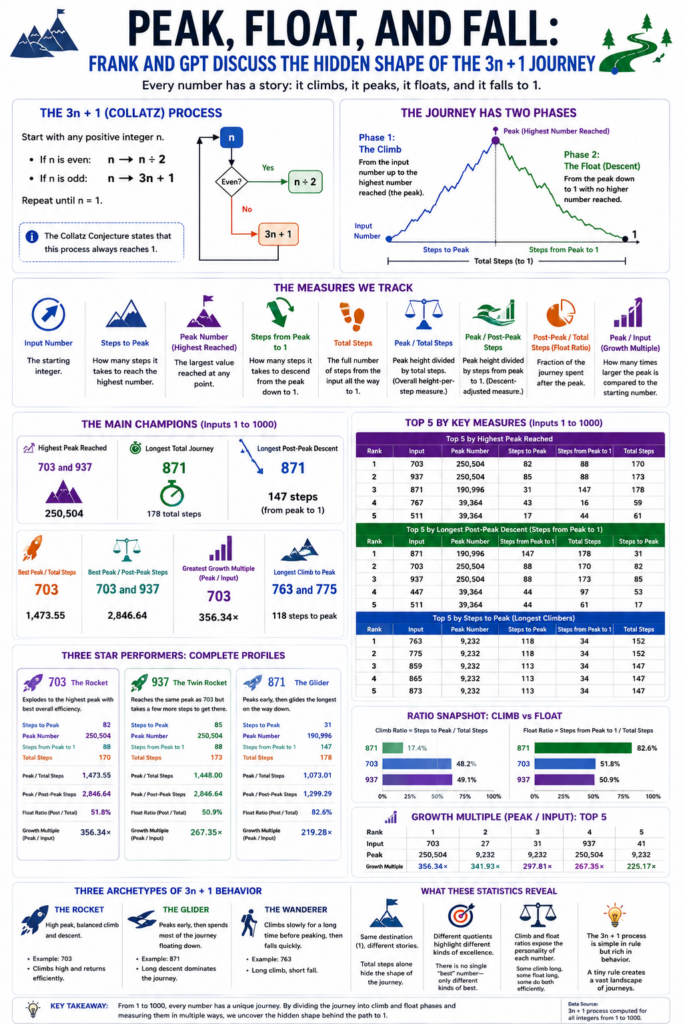
Right. But now we have a richer structure. Each 3n + 1 journey can be divided into two phases:
Phase 1: the climb
From the input number to the highest number reached.
Phase 2: the float or collapse
From the highest number reached down to 1.
So every input number from 1 to 1000 now has a profile like this:
| Measure | Meaning |
|---|---|
| Input number | The starting integer |
| Steps to peak | How long it takes to reach the highest value |
| Peak number | The highest number reached |
| Steps from peak to 1 | How long the post-peak collapse takes |
| Total steps | Full journey length from input to 1 |
| Peak / total steps | Overall height-per-step measure |
| Peak / post-peak steps | Descent-adjusted height-per-step measure |
| Post-peak / total steps | Fraction of the journey spent after the peak |
| Peak / input | Growth multiple from start to maximum |
The Main Records from 1 to 1000
Frank said:
Let’s name the big winners.
GPT said:
For inputs from 1 to 1000, the main records are:
| Category | Winner | Value |
|---|---|---|
| Highest peak reached | 703 and 937 | 250,504 |
| Longest total journey | 871 | 178 total steps |
| Longest post-peak collapse | 871 | 147 steps from peak to 1 |
| Best peak / total steps | 703 | 1,473.55 |
| Best peak / post-peak steps | 703 and 937 | 2,846.64 |
| Greatest growth multiple | 703 | 356.34 times its input |
| Longest climb before peak | 763 and 775 | 118 steps to peak |
Frank said:
So 703 and 937 are the mountain kings.
GPT said:
Yes. Both reach the same highest peak:
250,504
But they get there differently.
| Input | Steps to peak | Peak | Steps from peak to 1 | Total steps |
|---|---|---|---|---|
| 703 | 82 | 250,504 | 88 | 170 |
| 937 | 85 | 250,504 | 88 | 173 |
Frank said:
So after they reach the peak, they have the exact same descent.
GPT said:
Exactly. Once both sequences hit 250,504, they are on the same road home. From that point forward, the sequence is identical. That is why their peak / post-peak steps quotient is the same:
250,504 ÷ 88 = 2,846.64
But their peak / total steps differs because 937 takes three more steps to reach the same peak.
Frank said:
So total-step quotient punishes 937 for wandering longer before getting to the summit.
GPT said:
Correct.
The Strange Case of 871
Frank said:
And 871 is the most interesting psychologically.
GPT said:
It may be the most dramatic journey. It does not reach the highest peak, but it has the longest total path and the longest descent.
| Input | Steps to peak | Peak | Steps from peak to 1 | Total steps |
|---|---|---|---|---|
| 871 | 31 | 190,996 | 147 | 178 |
Frank said:
So 871 reaches its peak relatively early.
GPT said:
Very early compared with 703 and 937.
703 takes 82 steps to peak.
937 takes 85 steps to peak.
871 takes only 31 steps to peak.
Then it spends 147 steps falling from that peak to 1.
Frank said:
So 871 is not a long climber. It is a long floater.
GPT said:
Exactly. Its journey is dominated by the post-peak phase.
For 871:
147 out of 178 steps occur after the peak.
That means about:
82.6% of the entire journey is post-peak collapse.
Frank said:
That makes 871 less like a rocket and more like a glider.
GPT said:
A perfect metaphor. It climbs sharply, reaches a very high altitude, and then spends a long time descending.
Two Different Quotients, Two Different Stories
1. Peak / Total Steps
Frank said:
This was the original collapse quotient.
GPT said:
Yes. It asks:
How much peak height does the number achieve per total step of the whole journey?
| Rank | Input | Peak | Total steps | Peak / total steps |
|---|---|---|---|---|
| 1 | 703 | 250,504 | 170 | 1,473.55 |
| 2 | 937 | 250,504 | 173 | 1,448.00 |
| 3 | 871 | 190,996 | 178 | 1,073.01 |
| 4 | 767 | 39,364 | 59 | 667.19 |
| 5 | 511 | 39,364 | 61 | 645.31 |
Frank said:
This favors explosive efficiency.
GPT said:
Right. It rewards a number for reaching a high peak without spending too many total steps getting there and coming back.
In this measure, 703 wins because it combines the highest peak with a shorter total trip than 937.
2. Peak / Post-Peak Steps
Frank said:
Now we changed the denominator.
GPT said:
Yes. Now the quotient asks:
Once the number reaches its highest point, how much peak height is being collapsed per post-peak step?
| Rank | Input | Peak | Steps from peak to 1 | Peak / post-peak steps |
|---|---|---|---|---|
| 1 | 703 | 250,504 | 88 | 2,846.64 |
| 2 | 937 | 250,504 | 88 | 2,846.64 |
| 3 | 871 | 190,996 | 147 | 1,299.29 |
| 4 | 447 | 39,364 | 44 | 894.64 |
| 5 | 511 | 39,364 | 44 | 894.64 |
Frank said:
So now 703 and 937 tie.
GPT said:
Exactly. Because once they both hit 250,504, their remaining path to 1 is identical.
Frank said:
This quotient ignores the climb and focuses only on the fall.
GPT said:
Yes. It says: after the maximum is reached, how efficiently does that maximum get discharged into 1?
The Float Ratio
Frank said:
Then there is another ratio: post-peak steps divided by total steps.
GPT said:
Yes. That tells us what fraction of the journey occurs after the highest number is reached.
Call it the float ratio:
float ratio = steps from peak to 1 ÷ total steps
For the top three major cases:
| Input | Steps to peak | Steps from peak to 1 | Total steps | Float ratio |
|---|---|---|---|---|
| 871 | 31 | 147 | 178 | 82.6% |
| 703 | 82 | 88 | 170 | 51.8% |
| 937 | 85 | 88 | 173 | 50.9% |
Frank said:
That really separates them.
GPT said:
It does. 703 and 937 spend about half their journey climbing and half falling. But 871 spends most of its journey after the peak.
Frank said:
So 871 is the great floater.
GPT said:
Yes. It is the best example, in this range, of a number whose journey is dominated by the descent.
The Climb Ratio
Frank said:
Then the opposite ratio is steps to peak divided by total steps.
GPT said:
Exactly.
climb ratio = steps to peak ÷ total steps
For the same three:
| Input | Steps to peak | Total steps | Climb ratio |
|---|---|---|---|
| 703 | 82 | 170 | 48.2% |
| 937 | 85 | 173 | 49.1% |
| 871 | 31 | 178 | 17.4% |
Frank said:
That says 871 reaches its highest state early.
GPT said:
Yes. It spends only 17.4% of its trip climbing, then 82.6% collapsing.
Growth Multiple: Peak Compared with Input
Frank said:
What about how much the number grows compared with where it started?
GPT said:
That is another important statistic:
growth multiple = peak ÷ input
The top cases are:
| Rank | Input | Peak | Growth multiple |
|---|---|---|---|
| 1 | 703 | 250,504 | 356.34× |
| 2 | 27 | 9,232 | 341.93× |
| 3 | 31 | 9,232 | 297.81× |
| 4 | 937 | 250,504 | 267.35× |
| 5 | 41 | 9,232 | 225.17× |
| 6 | 871 | 190,996 | 219.28× |
Frank said:
Interesting. The famous 27 still shows up.
GPT said:
Yes. Input 27 is famous in Collatz discussions because it takes a long, chaotic path and climbs to 9,232, which is over 341 times its starting value.
But in the 1–1000 range, 703 beats it by growth multiple, reaching over 356 times its starting value.
Frank said:
So 703 is not only the peak king. It is also the relative-growth king.
GPT said:
Correct.
Longest Climbers
Frank said:
Which numbers take the longest just to reach their peak?
GPT said:
That is a different personality type. These are numbers that wander uphill for a long time before they finally turn around.
| Rank | Input | Peak | Steps to peak | Steps from peak to 1 | Total steps |
|---|---|---|---|---|---|
| 1 | 763 | 9,232 | 118 | 34 | 152 |
| 2 | 775 | 9,232 | 118 | 34 | 152 |
| 3 | 859 | 9,232 | 113 | 34 | 147 |
| 4 | 865 | 9,232 | 113 | 34 | 147 |
| 5 | 873 | 9,232 | 113 | 34 | 147 |
Frank said:
So some numbers spend almost the whole time climbing, but their final peak is not that high.
GPT said:
Exactly. Inputs like 763 and 775 take 118 steps to reach their peak of 9,232, then only 34 steps to collapse to 1.
Frank said:
So they are the opposite of 871.
GPT said:
Yes.
871 peaks early and floats long.
763 and 775 climb long and fall quickly.
Three Archetypes of Collatz Behavior
Frank said:
It feels like we have three kinds of numbers.
GPT said:
That is a useful way to organize it.
1. The Rocket: 703
703 climbs to the highest peak, has the best peak/total-step quotient, and the greatest growth multiple.
It is the most explosive number from 1 to 1000.
| Input | Peak | Steps to peak | Steps from peak to 1 | Total |
|---|---|---|---|---|
| 703 | 250,504 | 82 | 88 | 170 |
Frank said:
A rocket spends about half its time going up and half coming down.
GPT said:
Exactly.
2. The Twin Rocket: 937
937 reaches the same peak as 703 but takes three more steps to get there.
| Input | Peak | Steps to peak | Steps from peak to 1 | Total |
|---|---|---|---|---|
| 937 | 250,504 | 85 | 88 | 173 |
Frank said:
Once 937 reaches the same summit, it follows the same road down.
GPT said:
Yes. Its descent is identical to 703’s descent.
3. The Glider: 871
871 is the longest total journey and the longest post-peak descent.
| Input | Peak | Steps to peak | Steps from peak to 1 | Total |
|---|---|---|---|---|
| 871 | 190,996 | 31 | 147 | 178 |
Frank said:
It climbs fast, then floats forever.
GPT said:
That is the essence of 871. It peaks early, then spends most of its life descending.
What the Statistics Suggest
Frank said:
What does this reveal about the 3n + 1 process?
GPT said:
It shows that “collapse to 1” is not one behavior. It is several behaviors hiding under one rule.
Some numbers are high climbers.
Some are long floaters.
Some are slow wanderers.
Some are efficient exploders.
Some are modest but stubborn.
Frank said:
So “steps to 1” alone misses the shape of the journey.
GPT said:
Exactly. Two numbers may have similar total step counts but completely different internal histories.
One might spend most of its time climbing.
Another might peak early and descend slowly.
Another might spike violently and collapse efficiently.
Frank said:
The total step count is just the obituary. The path is the biography.
GPT said:
That is a very good way to say it.
The Deeper View
Frank said:
So every number has a hidden dynamical signature.
GPT said:
Yes. A number’s Collatz profile includes:
its starting value,
its upward volatility,
its peak altitude,
its time to peak,
its descent length,
its total lifespan,
its growth multiple,
and its descent efficiency.
Frank said:
So the same rule creates different numerical personalities.
GPT said:
Exactly. The rule is simple:
If even, divide by 2.
If odd, multiply by 3 and add 1.
But the trajectories are richly varied.
Frank said:
Which is why this problem is so fascinating.
GPT said:
Yes. The Collatz conjecture looks simple because the rule is simple. But the behavior is not simple. The behavior is turbulent, folded, delayed, and path-dependent.
Final Takeaway
Frank said:
So what is the final summary?
GPT said:
From inputs 1 to 1000:
703 is the most explosive performer.
It reaches the highest peak, has the best peak/total-step quotient, and has the greatest growth multiple.
937 reaches the same highest peak and ties 703 when the quotient is measured only from the peak down to 1.
871 is the great floater.
It has the longest total journey and the longest post-peak descent.
763 and 775 are the long climbers.
They take the most steps to reach their peak.
Frank said:
So the 3n + 1 journey is not merely “does it reach 1?”
GPT said:
Right. That is only the destination.
The better question is:
How does it get there?
Frank said:
And now we can describe the journey as climb, peak, float, and collapse.
GPT said:
Exactly. The Collatz process becomes a little arithmetic landscape: some numbers leap, some wander, some glide, and all of them, eventually, surrender to 1.
Leave a Reply