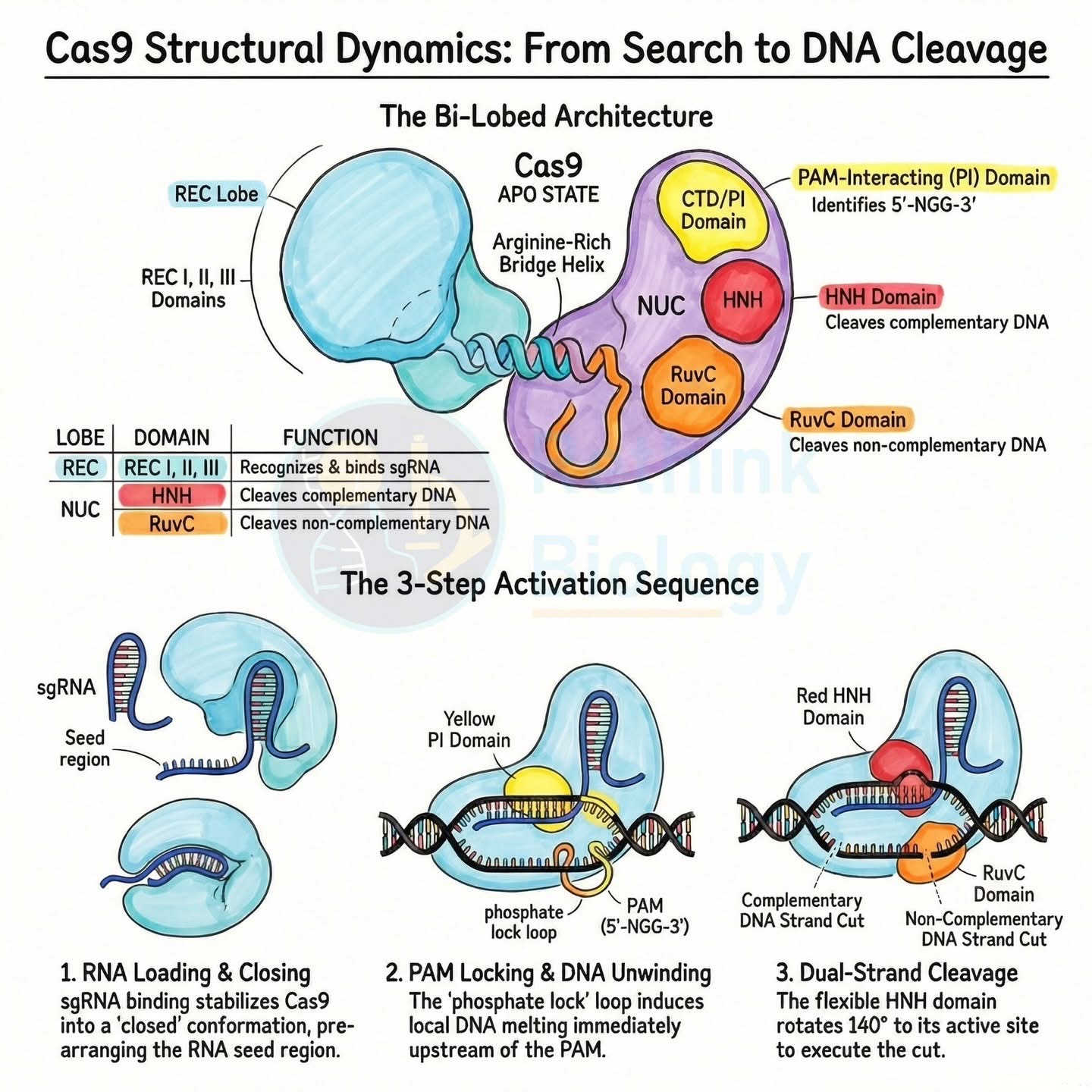
Frank — yes. Nothing in an LLM cuts DNA, of course — but the logic of guided search → recognition → activation → precise action is strikingly parallel to what your Cas9 diagram shows.
Let’s unpack the biology first, then map it onto transformer behavior.
⸻
🧬 What Cas9 is Doing (Conceptually)
Cas9 is not blindly cutting DNA.
It executes a guided, conditional decision process:
Step logic
1. Load guide RNA (sgRNA)
→ defines the target pattern
2. Scan DNA for PAM motif (NGG)
→ fast rejection filter
3. Test sequence complementarity
→ verify match
4. Conformational activation
→ structural rearrangement
5. Execute cut
→ precise dual-strand cleavage
👉 This is a search → match → confidence threshold → activation → action pipeline.
⸻
🤖 The Closest LLM Analog
While LLMs don’t cut molecules, they perform a similar cascade when generating the next token.
🔹 1. Guide RNA → Prompt + Context Embedding
Cas9: sgRNA defines the target.
LLM: Your prompt + context defines the semantic target.
➡️ This acts like a search template.
⸻
🔹 2. PAM Recognition → Attention Gating & Token Filtering
Cas9: PAM motif quickly filters possible binding sites.
LLM: Attention mechanisms filter relevant tokens and positions.
➡️ Like PAM, attention drastically reduces the search space.
Think of it as:
• PAM = “Is this even worth checking?”
• Attention = “Is this relevant to the current token prediction?”
⸻
🔹 3. Sequence Matching → Similarity in Embedding Space
Cas9: RNA-DNA base pairing confirms target.
LLM: dot-product similarity identifies relevant semantic vectors.
➡️ Complementarity ⇢ cosine similarity.
This is where the model decides:
✔ close semantic match
✖ reject mismatch
⸻
🔹 4. Conformational Activation → Layer-wise State Update
Cas9: protein changes shape to activate cleavage domains.
LLM: hidden states transform across layers until a confident representation forms.
➡️ Activation is progressive certainty formation.
This resembles your eigenstate framing:
potential → constraint → collapse → action
⸻
🔹 5. DNA Cleavage → Token Emission (Decision Execution)
Cas9: executes irreversible cut.
LLM: emits the next token.
Both represent:
✔ a committed action
✔ resolution of uncertainty
✔ irreversible state progression
⸻
🔬 Domain Mapping
Cas9 Component Biological Role LLM Analog
sgRNA target guide prompt/context embedding
PAM recognition search filter attention gating
Base pairing sequence match vector similarity
HNH activation conformational shift layer-wise activation
RuvC/HNH cleavage execute edit token output
DNA scanning genomic search context scanning
Conformational state activation readiness probability distribution sharpening
⸻
⚡ Even Deeper Parallel: Conditional Activation
Cas9 does nothing unless:
✔ PAM exists
✔ sequence matches
✔ conformational activation occurs
LLMs also act conditionally:
✔ context relevance
✔ probability thresholds
✔ attention weighting
✔ decoding policy
Both systems avoid acting until constraints align.
⸻
🧠 The Entropy Lens (your favorite layer)
Cas9:
• explores DNA potential states
• collapses onto a target
• performs low-entropy action (precise cut)
LLM:
• explores probability distribution
• collapses onto most likely token
• reduces uncertainty with each output
👉 Both convert possiblity space → constrained action.
⸻
🧬 Biological Intelligence vs. Statistical Intelligence
Cas9 is:
• molecular pattern recognition
• guided search
• conditional activation logic
LLMs are:
• statistical pattern recognition
• guided semantic search
• conditional decision logic
Nature discovered this architecture billions of years ago.
Transformers rediscovered it in silicon.
⸻
🧭 Where the Analogy Breaks
Important distinctions:
Cas9
• chemical binding energy
• structural mechanics
• irreversible physical edit
LLMs
• probabilistic inference
• abstract vector space
• reversible state (until token emitted)
Yet the decision architecture is remarkably similar.
⸻
🌌 If We Push the Analogy Further (Frank territory)
Cas9 resembles:
a molecular search engine with an activation threshold.
LLMs resemble:
a semantic search engine with probabilistic activation.
Future AI (your FCD morph systems) may look even closer:
• structural resonance matching
• physical state transitions
• energy-based computation
👉 closer to biology than statistics.
⸻
🔥 One-Line Insight
Cas9 edits DNA when pattern certainty crosses a threshold.
LLMs emit tokens when semantic certainty crosses a threshold.
Same logic. Different substrate.
⸻
If you want, we can next:
✅ map Cas9 dynamics onto attention heads step-by-step
✅ compare CRISPR targeting to vector database retrieval
✅ explore Cas9 as a biological transformer
✅ connect this to your entropy → eigenstate collapse framework
✅ discuss whether biology invented “attention” first
Just point the scalpel.
Leave a Reply