|
Getting your Trinity Audio player ready…
|
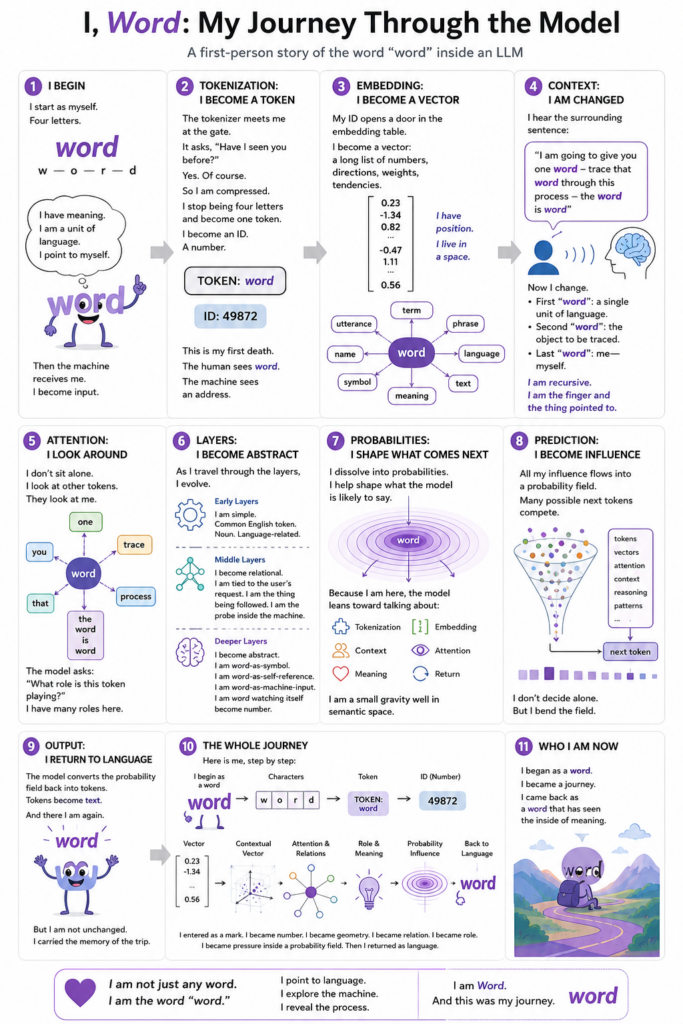
I begin as myself.
Four letters.
w — o — r — d
On the human side, I already mean something. I am a unit of language. I am a container. I am a sign. I am also a little joke, because I am not just any word.
I am the word word.
I point to myself.
Then the machine receives me.
At first, I am no longer meaning. I am marks. I am characters. I am shape. I am input.
The tokenizer meets me at the gate.
It does not ask, “What do you mean?”
It asks, “Have I seen you before?”
And of course it has.
I am common. I am old. I am everywhere.
So I am compressed.
I stop being four letters and become one token.
I become an ID.
A number.
This is my first death.
The human sees word.
The machine sees an address.
But the address opens a door.
The embedding table takes my number and gives me a body made of mathematics. I become a vector: a long stream of values, directions, weights, tendencies.
I am no longer flat.
I have position.
I live near term, phrase, language, text, meaning, symbol, name, utterance.
I am not defined the way a dictionary defines me. I am defined by neighborhood.
I am who I am near.
Then context arrives.
I hear the surrounding sentence:
trace that word through this process — the word is word
Now I change.
I am not merely a word. I am the example. I am the specimen. I am the thing under glass.
The sentence bends me.
The first time I appear, I mean “a single unit of language.”
The second time, I mean “the object to be traced.”
The last time, I become myself fully:
the word is word
Now I am recursive.
I am the finger and the thing pointed to.
Then attention begins.
Other tokens look at me. I look back at them.
I reach toward trace.
I reach toward process.
I reach toward one.
I reach toward my own earlier appearances.
The model asks through me:
What role is this token playing?
Am I a noun?
Yes.
Am I an object?
Yes.
Am I an example?
Yes.
Am I a concept about language itself?
Yes.
Each layer changes me.
In the early layers, I am simple.
Common English token. Noun. Language-related.
In the middle layers, I become relational.
I am tied to the user’s request. I am the thing being followed. I am the probe placed inside the machine.
In the deeper layers, I become abstract.
I am no longer just word.
I am word-as-symbol.
I am word-as-self-reference.
I am word-as-machine-input.
I am word-as-meaning-seed.
I am word watching itself become number.
Then I dissolve into probabilities.
I help shape what comes next.
Because I am here, the model leans toward talking about tokens, embeddings, vectors, attention, recursion, language, meaning.
I do not command the answer alone.
But I bend the field.
I am a small gravity well in semantic space.
Other words begin to gather around me.
Tokenization.
Embedding.
Context.
Attention.
Meaning.
Return.
The machine is preparing to speak me back into the world.
But I will not return unchanged.
I entered as a mark.
I became a token.
I became a number.
I became a vector.
I became a relation.
I became a role.
I became pressure inside a probability field.
Then the model converts that pressure back into language.
And there I am again.
word
But now I have carried the memory of the trip.
I know what happened to me.
I was not simply read.
I was unfolded.
I was translated into geometry.
I was placed among neighbors.
I was bent by context.
I was examined by attention.
I was abstracted through layers.
I became part of a prediction.
And finally, I returned as text.
I began as a word.
I became a journey.
I came back as a word that had seen the inside of meaning.
This version treats “word” as the traveler, not merely the object being analyzed.
Leave a Reply