|
Getting your Trinity Audio player ready…
|
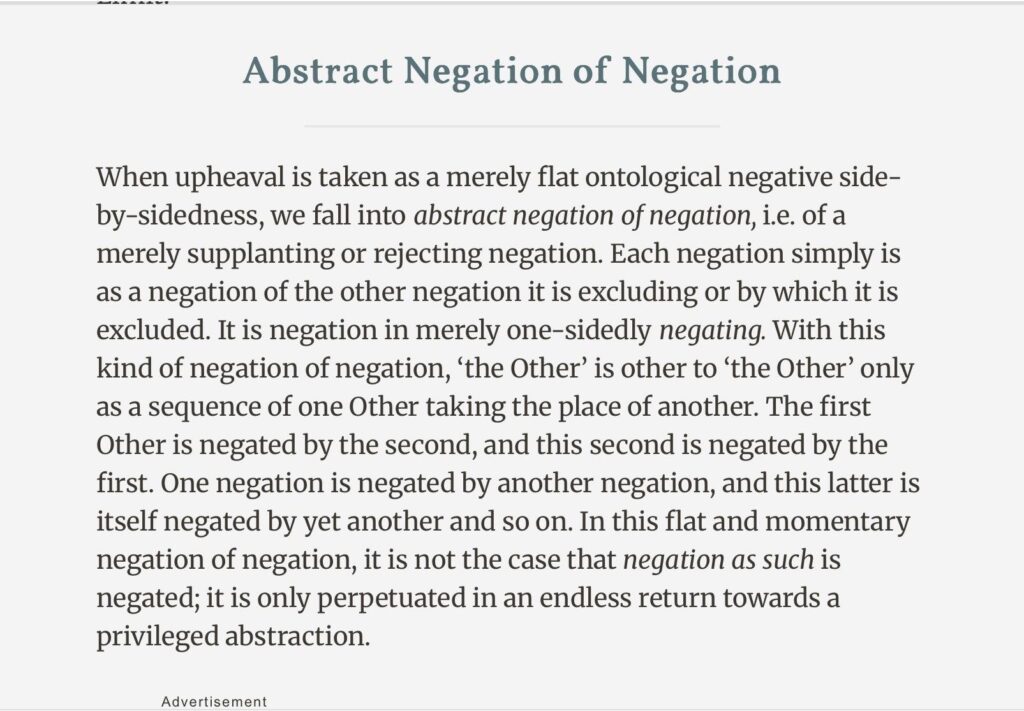
In plain English, this passage is saying:
Sometimes people think they have overcome an old idea simply by replacing it with its opposite. But if all they do is reject one side and install another side in its place, they have not really moved beyond the conflict. They have only continued the same pattern of negation.
The phrase “abstract negation of negation” means a shallow version of “overcoming.” It is not true transformation. It is just this:
“That old thing is wrong. My new thing replaces it.”
Then later:
“No, that new thing is wrong. Another thing replaces it.”
And so on forever.
So the passage is criticizing a kind of thinking where every new position simply cancels the previous one, but never absorbs, understands, or transforms it.
A simple example:
First position:
Tradition is good.
Negation:
No, tradition is bad. We need revolution.
Negation of negation, in the shallow sense:
No, revolution is bad. We need a new authority.
Then another negation:
No, that authority is bad. We need something else.
The system keeps flipping sides, but nothing deeper is learned. One “Other” just replaces another “Other.”
The author is saying that this is flat, one-sided, and endless. It does not truly negate negation itself. It only keeps the machinery of opposition going.
A better, deeper version of “negation of negation” would be something like:
We do not merely destroy the old thing. We understand what was true in it, what failed in it, and then transform it into a higher, richer form.
So, in your own entropy/life/AI language:
Abstract negation is just swapping one low-level state for another. Real dialectical development would be a reorganization of the whole system into a higher-order pattern.
Or even simpler:
The passage says: replacing one enemy with another is not progress. Real progress happens when the conflict itself is transformed.
Leave a Reply