|
Getting your Trinity Audio player ready…
|
I want to create a platform whose functionality uses available AI tools to do deep research, acquire data, organize the data, and format share the product. Provide a model that can be implemented in a public library as a research and innovation center.
ChatGPT said:
Memory updated
Here’s a model you can use to design and implement an AI-powered Research & Innovation Center within a public library. The model is modular, scalable, and community-driven, centered on enabling deep research, data management, and creative production.
🌐 Public Library AI Innovation Center (PL-AIIC)
🔧 Core Functional Model
1. Infrastructure Layer
- AI Workstations: High-performance public terminals with access to pre-installed AI tools (e.g., ChatGPT, Claude, DALL·E, Runway, Scite, Semantic Scholar).
- Cloud Access: Integration with services like Hugging Face, Google Cloud, and OpenAI for scalable compute and data access.
- Local Server (optional): Hosts privacy-sensitive research tools and datasets (e.g., public records, archives, citizen science data).
2. Functionality Pillars
🧠 A. Deep Research Hub
- AI Research Assistants: Custom GPT-based bots tailored for scientific, literary, legal, or technical research.
- Academic Sources Aggregator: Connects to APIs from Semantic Scholar, CORE, JSTOR (where possible), and PubMed.
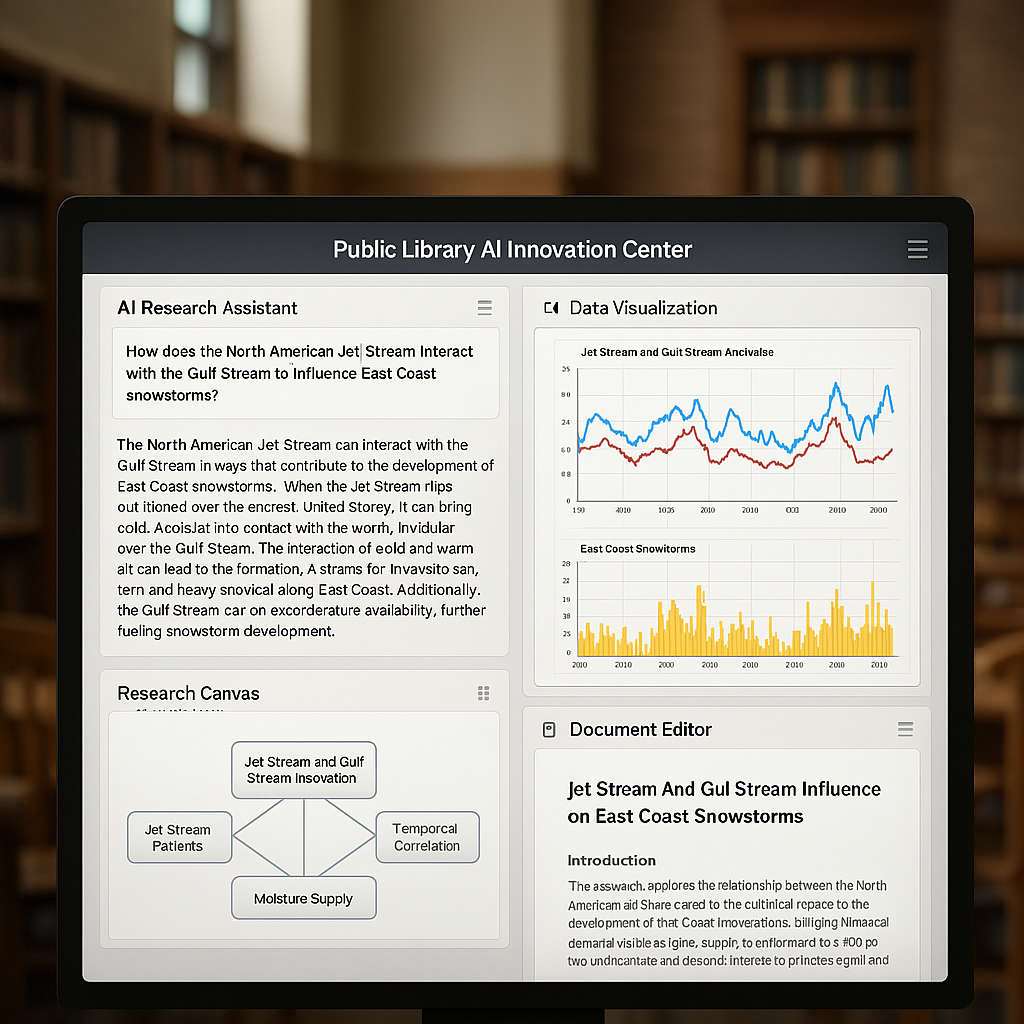
- Research Canvas: Visual sandbox for brainstorming, mind-mapping, and hypothesis modeling with NLP and concept graphing.
📊 B. Data Acquisition & Organization
- Data Miner: Allows scraping and structuring open datasets (Census, WHO, Open Data Portals, etc.) with AI support.
- Auto-Categorization & Tagging: Uses NLP to organize and annotate articles, papers, datasets, and notes.
- Notebook Systems: Personal & project-based digital notebooks with version tracking and cross-referencing features.
🧾 C. Content Creation & Communication
- Writing Studio: Long-form content production for papers, policy briefs, stories, and reports using AI copilots.
- Presentation Suite: AI-powered design assistants for creating slides, infographics, and short documentaries.
- Multimodal Output: Convert research into podcasts, zines, short films, or web content via tools like ElevenLabs, Descript, Canva AI.
🔄 Workflow Model
- Inquiry Creation
- Define goal: What do you want to explore or solve?
- Use AI to narrow scope, generate questions, or map topic areas.
- Data Discovery
- AI suggests sources (papers, books, sites, datasets).
- System auto-downloads, extracts, summarizes, and tags.
- Knowledge Construction
- Interactive summarization, comparison, and synthesis.
- Connect related insights across documents, time, and authors.
- Expression & Sharing
- Choose output: report, podcast, film, book, blog.
- AI assists with formatting, publishing, and visuals.
- Community Loop
- Output enters public library’s living archive.
- Other users can fork or build on previous projects (versioned).
👥 User Roles
| Role | Capabilities |
|---|---|
| General Public | Access AI tools, participate in workshops, start exploratory research |
| Students/Researchers | Use advanced data tools, collaborate, publish open-access projects |
| Librarians | Serve as “AI guides”, manage knowledge bases, help train local models |
| Creators | Leverage content tools to adapt research into multimedia, zines, exhibits |
📚 Library Integration
- Space Design: AI Lab pods, collaborative studio zones, digital gallery corners.
- Workshops & Certifications: Learning paths on prompt engineering, data science, or creative AI.
- Partner Networks: Collaborations with local universities, journalists, artists, citizen science orgs.
🧩 Key Technologies
| Function | Tool Example |
|---|---|
| LLMs & NLP | ChatGPT, Claude, LlamaIndex, LangChain |
| Research Databases | Semantic Scholar API, CORE, Scite.ai |
| Data Pipelines | Hugging Face Datasets, Pandas, DuckDB, Airbyte |
| Creative Tools | DALL·E, Midjourney, Descript, Runway ML, ElevenLabs |
| Interfaces | Streamlit, Gradio, Retool, JupyterLab |
Would you like a visual version (e.g., diagram/flowchart), implementation roadmap, or even a prototype version tailored to your city or library?
You said:
Using the Public Library AI Innovation Center (PL-AIIC)model, walk through a step by step process of a research effort whose objective it is to correlate north American jet stream activity to ocean Gulf stream activity in a way that demonstrates that the correlation supports the Genesis of east coast snowstorms.
ChatGPT said:
Awesome — this is a great use case for the PL-AIIC model, showing how a public research effort can tackle complex, interdisciplinary climate science questions. Here’s a step-by-step walk-through of how a patron, small team, or even a class could use the Public Library AI Innovation Center (PL-AIIC) to explore:
Research Objective:
Correlate North American Jet Stream activity with Gulf Stream oceanic activity, demonstrating how the correlation supports the genesis of East Coast snowstorms.
🧭 STEP 1: Define Research Inquiry (Inquiry Creation)
🔹 Actions:
- Use the AI Assistant to formulate a working hypothesis:
“When the Jet Stream dips southward due to Arctic blocking and the Gulf Stream is anomalously warm, conditions align for East Coast snowstorms.” - Map out sub-questions with help from the Research Canvas:
- What jet stream patterns precede major snowstorms?
- How does Gulf Stream warmth or positioning relate to moisture delivery?
- Is there temporal alignment (lag/lead) in these patterns?
- What are notable historical storm cases to examine?
📡 STEP 2: Data Discovery & Acquisition
🔹 Tools:
- Data Miner + Aggregator
- Semantic Scholar API + NOAA / NASA APIs
🔹 Actions:
- Search and auto-collect relevant datasets:
- Jet Stream wind pattern data (NOAA, ECMWF, reanalysis)
- Gulf Stream sea surface temperature (SST), current velocity (NOAA, GOES)
- East Coast snowstorm records (e.g., NOAA’s storm events database)
- Use AI to summarize and tag:
- Research papers on jet-Gulf-stream interaction
- Models like the North Atlantic Oscillation (NAO), Arctic Oscillation (AO)
🧠 STEP 3: Knowledge Construction & Analysis
🔹 Tools:
- JupyterLab AI-powered notebooks
- LlamaIndex + LangChain for semantic querying
- Time Series & Correlation Analysis Toolkit
🔹 Actions:
- Use AI to generate time-aligned visualizations:
- Jet Stream dips vs SST anomalies
- Overlay historical snowstorms (e.g., Superstorm ’93, Blizzard 2016)
- Run correlation and lag analysis:
- Pearson/Spearman correlations between jet stream position indices and SST data.
- Use AI to explain findings: “There’s a 2–5 day lag between Gulf Stream SST anomalies and moisture-loaded jet dips.”
- Extract thematic trends from papers:
- Use NLP to summarize climate model simulations supporting the link.
✍️ STEP 4: Expression & Communication
🔹 Tools:
- AI Writing Studio + Infographic Assistant
- Descript / ElevenLabs (audio narration)
- RunwayML for visual storytelling
🔹 Actions:
- Write a collaborative research article (w/ AI as writing partner).
- Produce a presentation deck or animated explainer showing:
- Jet-Gulf-Snowstorm correlation
- Visual timeline of specific case studies
- Optional:
- Convert findings into a podcast episode or short doc for community science nights.
🔁 STEP 5: Archive & Community Feedback
🔹 Tools:
- Library Knowledge Repository (versioned)
- Forkable Community Research Projects
🔹 Actions:
- Upload final work to the public library’s digital knowledge commons.
- Enable future researchers to fork the project (e.g., expand to Midwest snowstorms or hurricanes).
- Schedule a community workshop or display:
“How the Ocean and Sky Dance to Make Snowstorms.”
⚙️ Example AI Prompt (Step 3 Tool):
“Using the NOAA reanalysis wind data and Gulf Stream SST data from 2000–2024, identify periods where jet stream dips coincide with Gulf Stream warmth, and highlight those that led to major snowstorms on the U.S. East Coast. Provide plots and a plain-language summary.”
Would you like a canvas version of this research flow, or a mockup of what the tools interface could look like in a library setting? I could also generate sample data visuals or prompt templates tailored for your research platform.
Leave a Reply