|
Getting your Trinity Audio player ready…
|
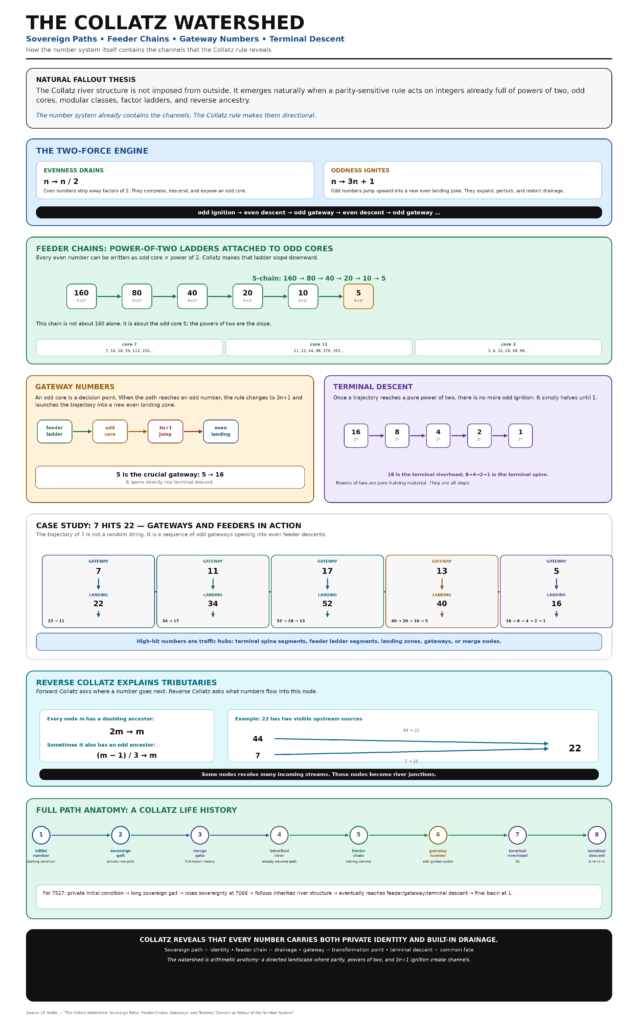
Yes. This structure is not something we are imposing from the outside. It is a natural consequence of the number system interacting with the Collatz rule.
The Collatz rule is simple:
if even: divide by 2
if odd: multiply by 3 and add 1
But that rule operates on a number system already full of hidden structure:
parity, divisibility, powers of two, modular classes, odd/even alternation, factor chains, and reverse ancestry.
So the river structure emerges naturally.
It is not arbitrary.
The number system already contains the channels.
The Collatz rule reveals them.
1. The number system already has a drainage direction
Even numbers are not neutral in Collatz.
Every even number contains a factor of 2.
So every even number can be written as:
odd core × power of 2
Examples:
160 = 5 × 2⁵
80 = 5 × 2⁴
40 = 5 × 2³
20 = 5 × 2²
10 = 5 × 2¹
5 = 5 × 2⁰
When Collatz sees an even number, it strips away one factor of 2:
160 → 80 → 40 → 20 → 10 → 5
So even numbers naturally form downward chains.
These are not random trajectories. They are built into the arithmetic structure of integers.
Every even number is already sitting on a descent ramp.
That is why feeder chains exist.
A feeder chain is simply the visible path made by repeatedly removing powers of 2 from a number.
2. Feeder chains are power-of-two ladders attached to odd cores
The chain:
160 → 80 → 40 → 20 → 10 → 5
is really:
5 × 2⁵ → 5 × 2⁴ → 5 × 2³ → 5 × 2² → 5 × 2¹ → 5
So the chain is not “about” 160 alone.
It is about the odd core:
5
The powers of two are just the slope.
This means every odd number has a potential feeder ladder above it:
m × 2ᵏ → m × 2ᵏ⁻¹ → … → m
For odd core 5:
5, 10, 20, 40, 80, 160, 320, 640…
For odd core 7:
7, 14, 28, 56, 112, 224…
For odd core 11:
11, 22, 44, 88, 176, 352…
So the natural form of a feeder chain is:
odd core × powers of two
The number system is full of these ladders.
Collatz simply makes them directional.
3. Gateway numbers are odd cores with special outbound behavior
An odd core is not the end of a chain. It is a decision point.
Once Collatz reaches an odd number, the rule changes:
n → 3n + 1
That odd number becomes a gateway because it hands the trajectory to a new even number.
For 5:
5 → 16
This is extraordinary because 16 is a pure power of two:
16 = 2⁴
So 5 is a gateway directly into terminal descent:
5 → 16 → 8 → 4 → 2 → 1
That makes 5 a very powerful gateway.
It is not merely “hit a lot” by accident. It sits at the bottom of a large feeder ladder and then opens directly into the final binary chute.
So the gateway architecture is:
feeder ladder → odd core → 3n+1 jump → new even landing zone
For 5:
5 × 2ᵏ → 5 → 16 → terminal descent
That is why the 5-chain is such a major traffic feature.
4. Terminal descent is the pure power-of-two spine
The terminal descent is:
16 → 8 → 4 → 2 → 1
This is the purest possible even descent.
Every number in this chain is a power of two:
16 = 2⁴
8 = 2³
4 = 2²
2 = 2¹
1 = 2⁰
Once a trajectory enters a power of two, there is no more branching, no more odd jump, no more uncertainty.
It simply halves until 1.
So terminal descent is the binary spine of the Collatz landscape.
It is the final attractor channel.
The reason it is so dominant is simple:
powers of two are the numbers that contain no odd structure except 1.
They are pure halving material.
They are all slope.
5. Sovereign trajectories are paths before the number joins an older channel
Now add history.
If we process numbers from 2 to 10,000, each new input either creates new path territory or enters a path already made by a smaller input.
The sovereign stage is the private part before that entry.
For 7527:
7527 remains sovereign for 118 steps
then enters common ground at 7066
So sovereignty is historical.
It is not just about the number’s path to 1. It is about whether that path has already been discovered by smaller inputs.
This creates a genealogical structure:
some numbers are ancestors
some numbers are descendants
some numbers are merge gates
some numbers are major inherited channels
That is why Collatz starts to look biological.
The arithmetic rule produces a kind of descent-with-modification.
6. Why the structure naturally falls out of parity
The deepest cause is parity.
Every Collatz step asks:
is the number even or odd?
This single question splits the entire number system into two kinds of motion.
| Number type | Collatz action | Effect |
|---|---|---|
| Even | divide by 2 | descent, compression, drainage |
| Odd | multiply by 3 and add 1 | ignition, expansion, new landing point |
So the Collatz world is built from two forces:
evenness drains
oddness ignites
Everything else follows from this.
A trajectory is a dance between ignition and drainage.
Odd numbers throw the path upward into even territory.
Even numbers drain the path downward until another odd core is exposed.
That creates the rhythm:
odd ignition → even descent → odd gateway → even descent → odd gateway…
This is why “gait” is such a good word.
Collatz is not just a path.
It is a repeated walking pattern.
7. Odd cores are exposed by even descent
Every even descent eventually reveals an odd core.
Example:
160 → 80 → 40 → 20 → 10 → 5
The odd core is 5.
Another example:
352 → 176 → 88 → 44 → 22 → 11
The odd core is 11.
Another:
96 → 48 → 24 → 12 → 6 → 3
The odd core is 3.
So even descent is a stripping process.
It removes powers of 2 until the hidden odd number is exposed.
This means the Collatz system is constantly doing two things:
stripping numbers down to odd cores
then transforming odd cores into new even structures
That is the engine.
8. The odd rule creates a new even landing zone
For any odd number n, the value:
3n + 1
is always even.
Why?
Because:
odd × 3 = odd
odd + 1 = even
So every odd number is guaranteed to produce an even landing zone.
That means every odd gateway launches the trajectory into a new halving chain.
Example:
7 → 22 → 11 → 34 → 17 → 52 → 26 → 13 → 40 → 20 → 10 → 5 → 16…
Here 7 does not simply move randomly.
It moves through a sequence of gateway and feeder structures:
7 → 22
11 → 34
17 → 52
13 → 40
5 → 16
Each odd number opens a door into an even ladder.
That is the architecture.
9. The number 7 demonstrates the structure beautifully
Your example:
7 hits 22
is perfect.
The trajectory begins:
7 → 22
Here 7 is an odd gateway.
It applies:
3 × 7 + 1 = 22
Now 22 is an even landing point.
Then:
22 → 11
So 22 is not just a number. It is a small feeder segment exposing the odd core 11.
Then:
11 → 34 → 17
Then:
17 → 52 → 26 → 13
Then:
13 → 40 → 20 → 10 → 5
Then:
5 → 16 → 8 → 4 → 2 → 1
So the trajectory of 7 is a chain of gateways and feeder ladders:
| Gateway odd core | Landing point | Feeder descent |
|---|---|---|
| 7 | 22 | 22 → 11 |
| 11 | 34 | 34 → 17 |
| 17 | 52 | 52 → 26 → 13 |
| 13 | 40 | 40 → 20 → 10 → 5 |
| 5 | 16 | 16 → 8 → 4 → 2 → 1 |
This is exactly the structure we are naming.
It is not metaphor only.
It is arithmetic anatomy.
10. The 5-chain is dominant because it feeds directly into terminal descent
The 5-chain is special because 5 is the odd core whose next jump lands on 16:
5 → 16
And 16 is pure terminal descent.
So every number of the form:
5 × 2ᵏ
eventually drains into:
5 → 16 → 8 → 4 → 2 → 1
Examples:
10 → 5 → 16
20 → 10 → 5 → 16
40 → 20 → 10 → 5 → 16
80 → 40 → 20 → 10 → 5 → 16
160 → 80 → 40 → 20 → 10 → 5 → 16
That is why these values are heavily hit.
They are not just numbers. They are pieces of a major arterial road.
11. Why 16 is more terminal than 5
5 is a gateway.
16 is the terminal entry.
The difference is important.
5 still requires an odd ignition:
5 → 16
16 requires no further ignition:
16 → 8 → 4 → 2 → 1
So 5 is the last odd gate.
16 is the start of the final pure descent.
That gives us:
5 = gateway into terminal river
16 = terminal riverhead
8, 4, 2, 1 = terminal spine
This is a clean distinction.
12. Why some numbers become high-hit channels
A number gets many hits if many upstream trajectories pass through it.
There are several reasons this happens:
It may sit on the terminal spine
Examples:
16, 8, 4, 2
These are hit by nearly everything because all known trajectories eventually descend through them.
It may sit on a major feeder ladder
Examples:
160, 80, 40, 20, 10, 5
These are hit by many trajectories because they feed directly into the terminal spine.
It may be a popular landing point from odd gateways
Example:
22
because:
7 → 22
and other higher trajectories may eventually pass through 7 or related paths.
It may be a merge point for many private trajectories
These are places where many sovereign paths lose anonymity.
So a high-hit number is a traffic hub.
It can be a spine segment, feeder segment, landing zone, gateway, or merge node.
13. The whole system is a directed watershed
The best picture is not a line.
It is a watershed.
Every number is a location in a directed drainage basin.
The Collatz rule gives every number one outgoing edge:
n → next Collatz value
So the whole number system becomes a directed graph.
Each number points to exactly one next number.
But many numbers can point into the same number.
That creates convergence.
For example, a number can be reached by halving reversal:
x can be reached from 2x
And sometimes by odd reversal:
x can be reached from (x – 1) / 3, if that is an odd integer
So some nodes receive many incoming streams.
Those become river junctions.
The result is:
not a random graph
not a single chain
but a directed arithmetic watershed
14. Reverse Collatz explains tributaries
Forward Collatz asks:
where does this number go next?
Reverse Collatz asks:
what numbers flow into this number?
Every number m can always be reached from:
2m
because:
2m → m
Sometimes m can also be reached from:
(m – 1) / 3
if that value is a positive odd integer.
Example:
22 can be reached from 44 because 44 → 22
22 can also be reached from 7 because 7 → 22
That means 22 has at least two upstream sources:
44 → 22
7 → 22
This is how tributaries form.
Some numbers have only the doubling ancestor.
Some have both doubling ancestry and odd-gateway ancestry.
The nodes with more reverse access become more important in the river network.
15. The structure is natural fallout from base-2 and base-3 tension
Collatz is especially interesting because it mixes two different arithmetic forces:
division by 2
multiplication by 3 plus 1
So it constantly moves between a base-2 world and a base-3 perturbation.
The even step is binary:
strip powers of two
The odd step is ternary expansion plus correction:
multiply by 3, then push to even with +1
So the rule creates a tension:
2-adic drainage versus 3n+1 ignition
The number system responds by forming channels.
Feeder chains are the 2-adic drainage paths.
Gateway numbers are the odd ignition points.
Terminal descent is the pure 2-adic collapse.
Sovereign trajectories are the stretches where this alternation has not yet joined older history.
That is the natural mechanism.
16. The path anatomy
A full Collatz life history can now be written like this:
initial number
→ sovereign gait
→ merge gate
→ post-sovereign inherited path
→ feeder chain
→ gateway number
→ terminal riverhead
→ terminal descent
→ 1
For 7527:
7527 begins as a private initial condition.
It travels through a long sovereign gait.
It loses sovereignty at 7066.
Then it follows inherited river structure.
Eventually it enters feeder/gateway/terminal descent.
It reaches the final basin at 1.
The key insight is that each stage has a different meaning.
It is not all one blur.
17. The Collatz landscape has layers
We can describe the landscape as layers:
| Layer | Description | Example |
|---|---|---|
| Sovereign layer | private new trajectory | 7527 before 7066 |
| Merge layer | first contact with known history | 7066 |
| Inherited river layer | already-traveled Collatz path | post-7066 descent |
| Feeder layer | high-traffic halving chains | 160 → 80 → 40 → 20 → 10 |
| Gateway layer | odd numbers that open new even landings | 5 → 16 |
| Terminal riverhead | start of final binary descent | 16 |
| Terminal spine | pure power-of-two collapse | 16 → 8 → 4 → 2 → 1 |
This is the watershed anatomy.
18. Why this feels like biology
The biological metaphor works because the system has:
private lineages
inherited paths
convergence
ancestry
preserved gaits
merge points
common descent
high-traffic channels
terminal attractors
A number’s trajectory resembles a lineage.
Before merge, it is historically private.
After merge, it follows inherited ancestry.
A feeder chain resembles a conserved pathway.
A gateway resembles a developmental switch.
Terminal descent resembles final convergence into a common attractor.
Again, this is not saying Collatz is biology.
It is saying both systems show how simple local rules generate layered historical structure.
19. The natural fallout thesis
Here is the strongest version:
The Collatz watershed is the natural fallout of applying a parity-sensitive rule to the integers.
Because integers already contain:
powers of two
odd cores
modular classes
reverse ancestry
factor ladders
convergence possibilities
And Collatz adds:
odd ignition
even drainage
repeated transformation
historical overlap
terminal attraction
Together, they generate:
sovereign trajectories
feeder chains
gateway numbers
terminal descent
So we do not need to invent the structure.
The structure is already latent in the number system.
The Collatz rule makes it visible.
20. Final synthesis
A Collatz number does not merely “go to 1.”
It passes through an arithmetic ecology.
It begins as an initial condition.
If it is lucky, or strange, or arithmetically positioned, it travels for a while as a sovereign trajectory.
Then it meets history.
It enters a river.
The river may carry it through feeder chains, where powers of two peel away.
The feeder chains expose odd gateway numbers.
The gateway numbers launch it into new even descents.
Eventually, one gateway opens into the terminal riverhead.
Then the number enters the final binary spine:
16 → 8 → 4 → 2 → 1
So the full Collatz story is:
private gait → inherited river → feeder chain → gateway → terminal descent
And that whole structure falls naturally out of the number system because every integer is already a mixture of:
odd identity and powers-of-two descent.
That may be the deepest plain-English statement:
Collatz reveals that every number carries both a private identity and a built-in drainage structure.
The sovereign path is the identity.
The feeder chain is the drainage.
The gateway is the transformation point.
The terminal descent is the final common fate.
Leave a Reply