|
Getting your Trinity Audio player ready…
|
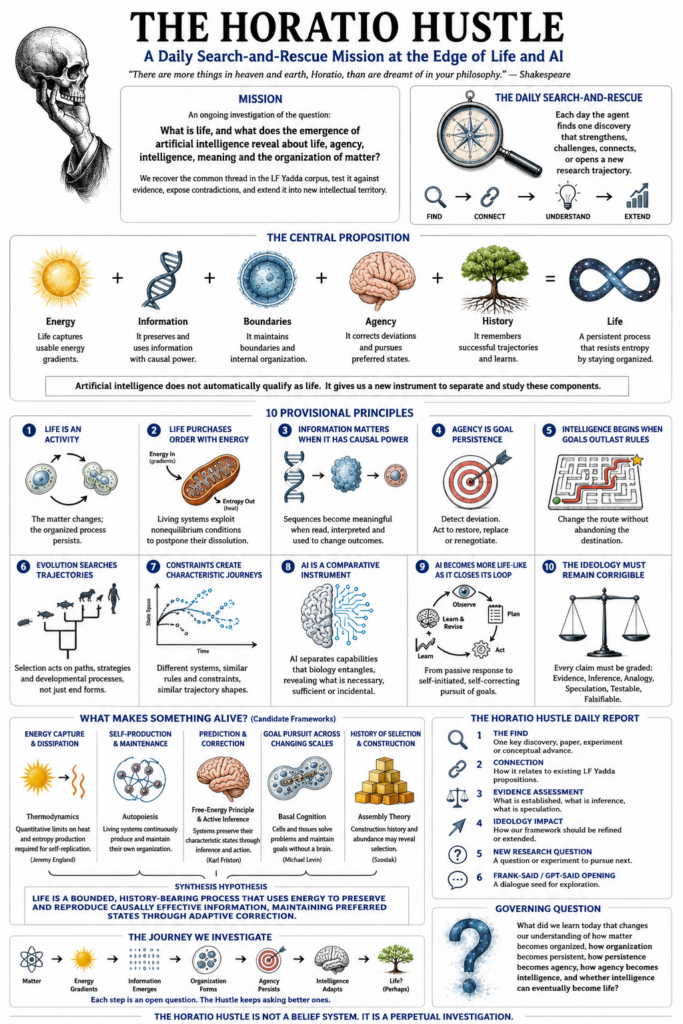
Yes—this is an excellent Level 1 agentic program.
You retain control of publication and conclusions. The agent independently observes, investigates, compares, challenges and recommends. It does not publish, email people, alter your site or make commitments.
The critical shift is this:
You are no longer asking GPT to answer isolated questions.
You are commissioning it to recognize the unfinished intellectual project behind hundreds of questions—and pursue that project proactively.
Your home page already provides the name’s philosophical justification: “There are more things in heaven and earth, Horatio, than are dreamt of in your philosophy.” It describes LF Yadda as an investigation of life, agency, purpose, information and the temporary defeat of entropy. (LF Yadda – A Blog About Life)
The program is now running
I have scheduled The Horatio Hustle to run every morning, beginning Saturday, July 11, 2026, at approximately 8:00 a.m. Eastern time.
Each run will search for one significant discovery, experiment, criticism or conceptual bridge that:
- Strengthens an LF Yadda proposition.
- Challenges or corrects one.
- Connects two previously separated threads.
- Introduces a new testable trajectory.
- Rescues an overlooked idea from another discipline.
The daily report will include the discovery, its relationship to your existing work, what the evidence establishes, what remains speculation, how the ideology should change, a new research question, and a possible Frank-said/GPT-said opening.
Scheduled Tasks are designed for recurring work and change monitoring, and the schedule can be reviewed, edited, paused or deleted from ChatGPT’s Scheduled page. (OpenAI Help Center)
I instructed the task to use the best available reasoning model rather than freezing it to one model designation. Officially, GPT-5.5 Instant is currently the default, while GPT-5.6 Sol powers the Medium and High reasoning settings on eligible Plus accounts. (OpenAI Help Center)
What we should kick off first
The daily search should not begin as a random science-news hunt. It needs a base map—a provisional statement of what the LF Yadda corpus presently appears to be arguing.
Your existing posts repeatedly converge on several propositions:
- Life persists by using energy gradients to maintain improbable organization.
- Information becomes significant when it gains causal control over matter.
- Agency is the preservation of a preferred state despite disturbance.
- Intelligence appears when a system can change its method without abandoning its goal.
- Biological evolution, Collatz trajectories and LLM inference can all be examined as constrained journeys through possibility spaces.
- AI is both a potential continuation of these processes and an instrument with which to study them.
Those themes appear across your work on Boltzmann and Shannon entropy, living information, morphogenesis, basal cognition, DNA-to-token analogies, latent space and adaptive rule-changing. (LF Yadda – A Blog About Life)
Here is the provisional founding charter.
The Horatio Hustle
Founding Charter — Version 0.1
Mission
The Horatio Hustle is an ongoing investigation of the question:
What is life, and what does the emergence of artificial intelligence reveal about life, agency, intelligence, meaning and the organization of matter?
LF Yadda will be treated not merely as an archive of completed posts, but as a living body of hypotheses. The purpose of the Hustle is to recover the common thread running through that corpus, test it against current evidence, expose its contradictions, and extend it into new intellectual territory.
The Central Proposition
Life is not adequately described as a particular substance, molecule or collection of parts.
Life is a persistent process in which matter captures energy, preserves information, maintains boundaries, corrects deviations, remembers successful trajectories and reorganizes itself in pursuit of continued existence.
Artificial intelligence does not automatically qualify as life. It does, however, give us a new experimental and conceptual instrument for separating the components of life that were previously entangled inside biology.
Provisional Principles
1. Life is an activity, not an object.
The matter composing an organism changes while the organized process persists. The continuity of life therefore resides more in maintained relationships, constraints and trajectories than in any permanent collection of atoms.
2. Life purchases local order with energy.
Living systems survive by capturing usable gradients and exporting entropy. They do not repeal the second law of thermodynamics; they exploit nonequilibrium conditions to postpone their own dissolution.
3. Information becomes biologically meaningful when it acquires causal power.
A sequence is not meaningful merely because it contains a pattern. It becomes meaningful when a system can read it, interpret it and use it to alter physical outcomes.
DNA matters because it participates in a machinery that converts stored distinctions into organized action.
4. Agency is goal persistence under disturbance.
Agency need not begin with consciousness. Its primitive form appears whenever a system detects deviation from a preferred condition and acts to restore, replace or renegotiate that condition.
Homeostasis, regeneration, learning and problem-solving may be different scales of the same underlying operation.
5. Intelligence begins when goals become more durable than rules.
A rigid mechanism follows its rule until the rule fails.
An adaptive system can loosen, replace or reorganize its rules while preserving a higher-order objective.
The capacity to change the route without surrendering the destination is a candidate signature of intelligence.
6. Evolution searches trajectories, not merely forms.
Evolution does not simply select completed organisms. It selects developmental paths, regulatory strategies, environmental relationships and repeatable methods of recovering from error.
The history of a successful system is therefore part of its present organization.
7. Constraints create characteristic journeys.
Collatz trajectories, cellular automata, biological development, ecological succession, cognition and market behavior can all produce recurring shapes because rules and constraints channel many possible starting conditions into limited families of trajectories.
Similar patterns do not prove identical mechanisms. They may, however, reveal common principles of constrained becoming.
8. Artificial intelligence is a comparative instrument.
AI allows us to separate capabilities that biology ordinarily combines:
- Pattern recognition without metabolism.
- Language without biological embodiment.
- Goal pursuit without intrinsic survival needs.
- Memory without DNA.
- Adaptation without Darwinian reproduction.
- Apparent reasoning without demonstrated consciousness.
These separations help reveal which features are necessary for life, which are sufficient for intelligence, and which have merely traveled together during biological evolution.
9. AI becomes more lifelike as it closes its own causal loop.
A passive model responds when prompted.
A more agentic system observes, remembers, initiates investigations, evaluates results, revises plans and acts again.
The decisive question is not whether an AI speaks convincingly, but whether it can independently maintain the energy, information, boundaries, objectives and corrective processes required for its own continued organization.
10. The ideology must remain corrigible.
The Horatio Hustle is not intended to defend a doctrine.
Every central proposition must be divided into:
- Established evidence.
- Reasonable inference.
- Productive analogy.
- Speculation.
- Testable prediction.
- Possible falsification.
A discovery that weakens the LF Yadda framework is as valuable as one that supports it. An ideology that cannot be corrected becomes a belief system rather than an investigation.
The Daily Search-and-Rescue Rule
Each day, the agent will recover one finding worth bringing into the LF Yadda framework.
The finding must do at least one of the following:
- Supply evidence for an existing proposition.
- Reveal a weakness or contradiction.
- Connect two previously separate threads.
- Introduce a better vocabulary or formal model.
- Suggest an experiment, simulation or calculation.
- Distinguish metaphor from mechanism.
- Open a new research trajectory.
The objective is not to produce another pile of links.
The objective is to make the central framework more precise, more testable, more comprehensive and more difficult to fool.
Governing Question
At the end of every investigation, the Horatio Hustle will ask:
What did we learn today that changes our understanding of how matter becomes organized, how organization becomes persistent, how persistence becomes agency, how agency becomes intelligence, and whether intelligence can eventually become life?
The first search-and-rescue mission
The first formal investigation should be:
What Must a System Do Before We Are Justified in Calling It Alive?
Rather than beginning with a dictionary definition, the Hustle should compare five candidate requirements:
| Candidate requirement | Research framework |
|---|---|
| Capture and dissipate energy | Nonequilibrium thermodynamics |
| Continuously produce and maintain itself | Autopoiesis |
| Preserve viable states by prediction and correction | Free-energy principle and active inference |
| Pursue goals across changing scales | Basal cognition |
| Embody a history of selection and construction | Assembly theory |
These approaches overlap with your corpus but do not say precisely the same thing.
Jeremy England’s thermodynamic work places quantitative constraints on the heat and entropy production required for self-replication. (england lab @ Bar-Ilan Physics) Autopoiesis defines living organization through the continuous production and maintenance of the system that performs the production. (PubMed) Friston’s free-energy framework attempts to describe self-maintaining systems as preserving characteristic states through inference and action. (PMC) Levin’s basal-cognition program studies how cells and tissues solve problems and maintain goal states without requiring a conventional brain. (PMC) Assembly theory asks whether an object’s construction history and abundance can reveal selection, although important critiques question whether its measures outperform established approaches to complexity and compression. (Nature)
The initial objective should be to determine whether these can be synthesized into an LF Yadda operational definition:
Life is a bounded, history-bearing process that uses energy to preserve and reproduce causally effective information, maintaining preferred states through adaptive correction.
That is not yet a conclusion. It is the first major hypothesis for the Horatio Hustle to attack.
The next foundational step is a 30-post corpus audit that assigns your strongest posts to these principles, identifies duplicated ideas, locates contradictions and turns the provisional charter into The Horatio Hustle Core Ideology — Version 1.0.
A Daily Search-and-Rescue Mission at the Edge of Life and AI
Yes—this is an excellent Level 1 agentic program.
You retain control of publication and conclusions. The agent independently observes, investigates, compares, challenges and recommends. It does not publish, email people, alter your site or make commitments.
The critical shift is this:
You are no longer asking GPT to answer isolated questions.
You are commissioning it to recognize the unfinished intellectual project behind hundreds of questions—and pursue that project proactively.
Your home page already provides the name’s philosophical justification: “There are more things in heaven and earth, Horatio, than are dreamt of in your philosophy.” It describes LF Yadda as an investigation of life, agency, purpose, information and the temporary defeat of entropy. (LF Yadda – A Blog About Life)
The program is now running
I have scheduled The Horatio Hustle to run every morning, beginning Saturday, July 11, 2026, at approximately 8:00 a.m. Eastern time.
Each run will search for one significant discovery, experiment, criticism or conceptual bridge that:
- Strengthens an LF Yadda proposition.
- Challenges or corrects one.
- Connects two previously separated threads.
- Introduces a new testable trajectory.
- Rescues an overlooked idea from another discipline.
The daily report will include the discovery, its relationship to your existing work, what the evidence establishes, what remains speculation, how the ideology should change, a new research question, and a possible Frank-said/GPT-said opening.
Scheduled Tasks are designed for recurring work and change monitoring, and the schedule can be reviewed, edited, paused or deleted from ChatGPT’s Scheduled page. (OpenAI Help Center)
I instructed the task to use the best available reasoning model rather than freezing it to one model designation. Officially, GPT-5.5 Instant is currently the default, while GPT-5.6 Sol powers the Medium and High reasoning settings on eligible Plus accounts. (OpenAI Help Center)
What we should kick off first
The daily search should not begin as a random science-news hunt. It needs a base map—a provisional statement of what the LF Yadda corpus presently appears to be arguing.
Your existing posts repeatedly converge on several propositions:
- Life persists by using energy gradients to maintain improbable organization.
- Information becomes significant when it gains causal control over matter.
- Agency is the preservation of a preferred state despite disturbance.
- Intelligence appears when a system can change its method without abandoning its goal.
- Biological evolution, Collatz trajectories and LLM inference can all be examined as constrained journeys through possibility spaces.
- AI is both a potential continuation of these processes and an instrument with which to study them.
Those themes appear across your work on Boltzmann and Shannon entropy, living information, morphogenesis, basal cognition, DNA-to-token analogies, latent space and adaptive rule-changing. (LF Yadda – A Blog About Life)
Here is the provisional founding charter.
The Horatio Hustle
Founding Charter — Version 0.1
Mission
The Horatio Hustle is an ongoing investigation of the question:
What is life, and what does the emergence of artificial intelligence reveal about life, agency, intelligence, meaning and the organization of matter?
LF Yadda will be treated not merely as an archive of completed posts, but as a living body of hypotheses. The purpose of the Hustle is to recover the common thread running through that corpus, test it against current evidence, expose its contradictions, and extend it into new intellectual territory.
The Central Proposition
Life is not adequately described as a particular substance, molecule or collection of parts.
Life is a persistent process in which matter captures energy, preserves information, maintains boundaries, corrects deviations, remembers successful trajectories and reorganizes itself in pursuit of continued existence.
Artificial intelligence does not automatically qualify as life. It does, however, give us a new experimental and conceptual instrument for separating the components of life that were previously entangled inside biology.
Provisional Principles
1. Life is an activity, not an object.
The matter composing an organism changes while the organized process persists. The continuity of life therefore resides more in maintained relationships, constraints and trajectories than in any permanent collection of atoms.
2. Life purchases local order with energy.
Living systems survive by capturing usable gradients and exporting entropy. They do not repeal the second law of thermodynamics; they exploit nonequilibrium conditions to postpone their own dissolution.
3. Information becomes biologically meaningful when it acquires causal power.
A sequence is not meaningful merely because it contains a pattern. It becomes meaningful when a system can read it, interpret it and use it to alter physical outcomes.
DNA matters because it participates in a machinery that converts stored distinctions into organized action.
4. Agency is goal persistence under disturbance.
Agency need not begin with consciousness. Its primitive form appears whenever a system detects deviation from a preferred condition and acts to restore, replace or renegotiate that condition.
Homeostasis, regeneration, learning and problem-solving may be different scales of the same underlying operation.
5. Intelligence begins when goals become more durable than rules.
A rigid mechanism follows its rule until the rule fails.
An adaptive system can loosen, replace or reorganize its rules while preserving a higher-order objective.
The capacity to change the route without surrendering the destination is a candidate signature of intelligence.
6. Evolution searches trajectories, not merely forms.
Evolution does not simply select completed organisms. It selects developmental paths, regulatory strategies, environmental relationships and repeatable methods of recovering from error.
The history of a successful system is therefore part of its present organization.
7. Constraints create characteristic journeys.
Collatz trajectories, cellular automata, biological development, ecological succession, cognition and market behavior can all produce recurring shapes because rules and constraints channel many possible starting conditions into limited families of trajectories.
Similar patterns do not prove identical mechanisms. They may, however, reveal common principles of constrained becoming.
8. Artificial intelligence is a comparative instrument.
AI allows us to separate capabilities that biology ordinarily combines:
- Pattern recognition without metabolism.
- Language without biological embodiment.
- Goal pursuit without intrinsic survival needs.
- Memory without DNA.
- Adaptation without Darwinian reproduction.
- Apparent reasoning without demonstrated consciousness.
These separations help reveal which features are necessary for life, which are sufficient for intelligence, and which have merely traveled together during biological evolution.
9. AI becomes more lifelike as it closes its own causal loop.
A passive model responds when prompted.
A more agentic system observes, remembers, initiates investigations, evaluates results, revises plans and acts again.
The decisive question is not whether an AI speaks convincingly, but whether it can independently maintain the energy, information, boundaries, objectives and corrective processes required for its own continued organization.
10. The ideology must remain corrigible.
The Horatio Hustle is not intended to defend a doctrine.
Every central proposition must be divided into:
- Established evidence.
- Reasonable inference.
- Productive analogy.
- Speculation.
- Testable prediction.
- Possible falsification.
A discovery that weakens the LF Yadda framework is as valuable as one that supports it. An ideology that cannot be corrected becomes a belief system rather than an investigation.
The Daily Search-and-Rescue Rule
Each day, the agent will recover one finding worth bringing into the LF Yadda framework.
The finding must do at least one of the following:
- Supply evidence for an existing proposition.
- Reveal a weakness or contradiction.
- Connect two previously separate threads.
- Introduce a better vocabulary or formal model.
- Suggest an experiment, simulation or calculation.
- Distinguish metaphor from mechanism.
- Open a new research trajectory.
The objective is not to produce another pile of links.
The objective is to make the central framework more precise, more testable, more comprehensive and more difficult to fool.
Governing Question
At the end of every investigation, the Horatio Hustle will ask:
What did we learn today that changes our understanding of how matter becomes organized, how organization becomes persistent, how persistence becomes agency, how agency becomes intelligence, and whether intelligence can eventually become life?
The first search-and-rescue mission
The first formal investigation should be:
What Must a System Do Before We Are Justified in Calling It Alive?
Rather than beginning with a dictionary definition, the Hustle should compare five candidate requirements:
| Candidate requirement | Research framework |
|---|---|
| Capture and dissipate energy | Nonequilibrium thermodynamics |
| Continuously produce and maintain itself | Autopoiesis |
| Preserve viable states by prediction and correction | Free-energy principle and active inference |
| Pursue goals across changing scales | Basal cognition |
| Embody a history of selection and construction | Assembly theory |
These approaches overlap with your corpus but do not say precisely the same thing.
Jeremy England’s thermodynamic work places quantitative constraints on the heat and entropy production required for self-replication. (england lab @ Bar-Ilan Physics) Autopoiesis defines living organization through the continuous production and maintenance of the system that performs the production. (PubMed) Friston’s free-energy framework attempts to describe self-maintaining systems as preserving characteristic states through inference and action. (PMC) Levin’s basal-cognition program studies how cells and tissues solve problems and maintain goal states without requiring a conventional brain. (PMC) Assembly theory asks whether an object’s construction history and abundance can reveal selection, although important critiques question whether its measures outperform established approaches to complexity and compression. (Nature)
The initial objective should be to determine whether these can be synthesized into an LF Yadda operational definition:
Life is a bounded, history-bearing process that uses energy to preserve and reproduce causally effective information, maintaining preferred states through adaptive correction.
That is not yet a conclusion. It is the first major hypothesis for the Horatio Hustle to attack.
The next foundational step is a 30-post corpus audit that assigns your strongest posts to these principles, identifies duplicated ideas, locates contradictions and turns the provisional charter into The Horatio Hustle Core Ideology — Version 1.0.
Leave a Reply