|
Getting your Trinity Audio player ready…
|
Frank said:
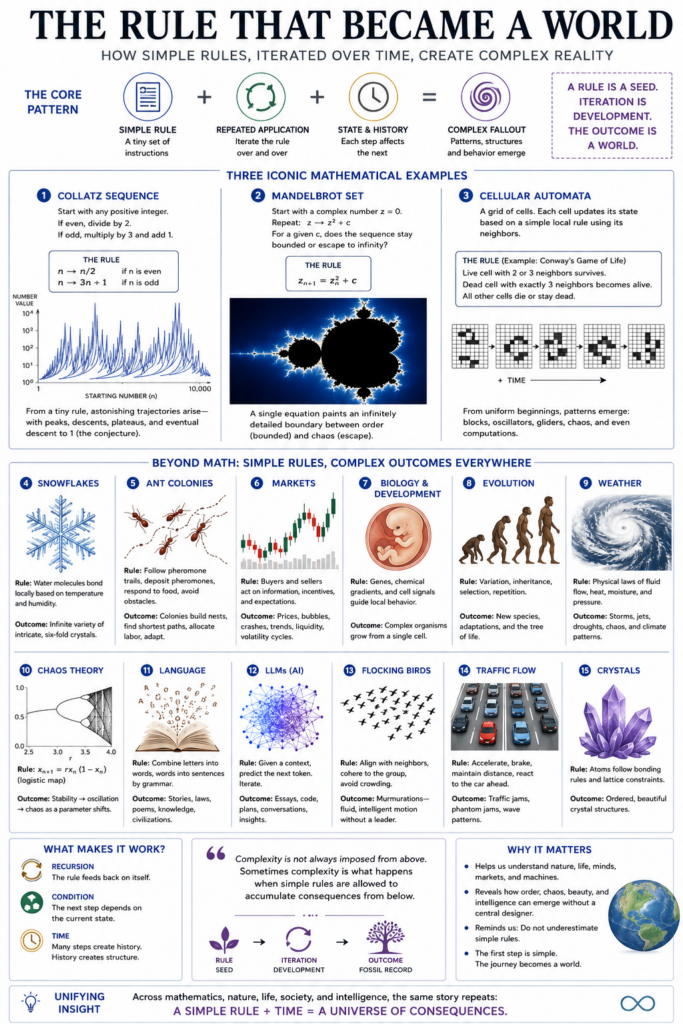
Collatz, the Mandelbrot set, and cellular automata all seem to point to the same mystery. You start with a simple rule. You iterate it. Then something much larger than the rule appears.
GPT said:
Exactly. They are all examples of what you might call iterated consequence. The rule itself is small, but once it is repeated, it generates history. And history becomes structure.
Frank said:
So the complexity is not sitting visibly inside the rule.
GPT said:
Right. The complexity is not in the first instruction. It is in the unfolding. Collatz says: if even, divide by two; if odd, multiply by three and add one. That sounds trivial. But run it across thousands of numbers and suddenly you get peaks, descents, feeder chains, gateways, shared rivers, and strange trajectory anatomies.
Frank said:
The Mandelbrot set does the same thing in another language.
GPT said:
Yes. The Mandelbrot rule is also tiny: repeatedly apply (z \rightarrow z^2 + c). But that little feedback loop creates one of the most intricate objects in mathematics. The boundary between escape and containment becomes endlessly detailed. It is almost as if the complex plane grows a coastline.
Frank said:
And cellular automata?
GPT said:
Cellular automata make the pattern visible in space and time. A cell follows a local rule based on its neighbors. That is all. But from that, you can get still lifes, oscillators, waves, gliders, chaos, order, and even computation. Conway’s Game of Life is the classic example: no one explicitly programs a glider, yet gliders appear.
Frank said:
So maybe the common structure is this: simple rule, repeated application, state history, complex fallout.
GPT said:
That is the pattern. A rule becomes interesting when it is forced to live through time.
Frank said:
Give me more examples.
GPT said:
There are many.
Snowflakes are a beautiful one. The rule is not a blueprint saying “make this exact crystal.” The rule is local chemistry: water molecules bond according to physical constraints. But repeated molecule by molecule, under temperature and humidity gradients, those local attachments produce elaborate six-fold forms.
Frank said:
So a snowflake is cellular automata in ice.
GPT said:
In a sense, yes. Local attachment rules become global geometry.
Ant colonies are another example. No single ant understands the colony. Each ant follows simple rules: follow pheromone trails, deposit pheromones, respond to food, avoid obstacles. But the colony as a whole discovers paths, allocates labor, builds nests, and adapts.
Frank said:
The intelligence is in the iteration of dumb local acts.
GPT said:
Exactly. The colony is not in the ant. The colony is in the loop.
Frank said:
That sounds like markets too.
GPT said:
Markets fit perfectly. Each trader follows partial information, incentives, fear, greed, and local signals. No one designs the full price pattern. Yet repeated buying and selling generate bubbles, crashes, trends, liquidity pools, volatility regimes, and herding behavior.
Frank said:
Simple decisions become economic weather.
GPT said:
Yes. A market is a cellular automaton made of money and expectation.
Frank said:
What about biology?
GPT said:
Biology may be the grandest case. DNA is not a full sculpture of the organism. It is more like a rule set, a generative program. Genes, regulatory networks, chemical gradients, epigenetic switches, and cell-to-cell signals iterate through development. From that, you get a body.
Frank said:
So the organism is not written out in DNA like a shopping list.
GPT said:
Correct. The organism is grown through rule-governed unfolding. DNA is closer to a constrained generator than a finished diagram.
Frank said:
Evolution too?
GPT said:
Evolution is another simple rule with enormous fallout: variation, inheritance, selection, repetition. No one tells evolution to make eyes, wings, fins, immune systems, flowers, or brains. But across deep time, that repeated filter creates astonishing form.
Frank said:
Simple rule: keep what works.
GPT said:
Yes — with mutation, recombination, environment, drift, and constraint adding richness. Evolution is iteration under survival pressure.
Frank said:
Weather?
GPT said:
Weather is governed by physical laws: fluid flow, heat transfer, pressure gradients, rotation, phase changes. The equations are compact compared with the resulting behavior. Iterate them over an atmosphere and you get clouds, storms, hurricanes, jet streams, droughts, and chaotic sensitivity to initial conditions.
Frank said:
The atmosphere is Mandelbrot with moisture.
GPT said:
That is a good line. Weather shows how deterministic rules can still be hard to predict because tiny differences amplify through time.
Frank said:
Like the butterfly effect.
GPT said:
Exactly. Chaos theory belongs in this family. The logistic map is a famous example:
(x_{n+1} = r x_n(1 – x_n)).
It is a simple equation. But as the parameter changes, the system moves from stability to oscillation to period-doubling to chaos.
Frank said:
A whole universe hiding in a little recurrence relation.
GPT said:
That is the theme.
Frank said:
What about language?
GPT said:
Language is built from simple combinatorial rules. A finite alphabet produces words. Words produce sentences. Sentences produce stories, laws, poems, religions, operating systems, and civilizations. Grammar is a rule system; culture is the fallout.
Frank said:
So Shakespeare is downstream of alphabetic cellular automata.
GPT said:
In a provocative sense, yes. Small symbolic units, recursively combined, generate enormous expressive space.
Frank said:
And LLMs?
GPT said:
LLMs belong here too. At inference time, the local operation is simple in spirit: given a context, predict the next token. But iterate that token rule and you get essays, code, arguments, poems, plans, analogies, and simulated conversations. The individual step is narrow. The trajectory becomes rich.
Frank said:
That is exactly the point. The intelligence is not in one token. It is in the path.
GPT said:
Yes. A single token is a move. A response is a trajectory. A long conversation becomes a kind of evolving semantic cellular automaton.
Frank said:
Any other examples?
GPT said:
Flocking birds. Each bird follows simple rules: avoid crowding neighbors, align with nearby birds, move toward the group. From that, you get murmuration — fluid aerial intelligence without a central conductor.
Traffic jams. Each driver follows simple rules: accelerate, brake, maintain distance, react to the car ahead. Yet phantom jams appear even without an accident.
Crystals. Atoms follow bonding rules. Repeated locally, they create macroscopic order.
Neural networks. Artificial neurons apply simple weighted sums and nonlinearities. Layer them, iterate training, and complex feature detectors emerge.
Fractals. A small geometric replacement rule, repeated, creates self-similar structure: coastlines, ferns, branching trees, lungs, blood vessels.
Fire spread. A spark plus local fuel, wind, dryness, and adjacency rules can generate vast, unpredictable burn patterns.
Urban growth. Individual decisions about roads, housing, trade, and proximity generate cities, neighborhoods, congestion, wealth gradients, and sprawl.
Cultural memes. Simple ideas copy, mutate, compete, and recombine. Over time they form traditions, ideologies, fashions, and institutions.
Frank said:
So this is not a mathematical oddity. It is a general pattern of reality.
GPT said:
Yes. The deeper principle is:
A simple rule becomes complex when it is recursive, conditional, and exposed to time.
Frank said:
Recursive because it feeds back on itself.
GPT said:
Correct.
Frank said:
Conditional because the next step depends on the current state.
GPT said:
Yes.
Frank said:
And exposed to time because one step is nothing, but many steps create history.
GPT said:
Exactly. History is what turns instruction into morphology.
Frank said:
That is the word: morphology. These systems grow shapes.
GPT said:
They grow mathematical, biological, social, computational, and semantic shapes. Collatz grows trajectory shapes. Mandelbrot grows boundary shapes. Cellular automata grow spacetime shapes. Evolution grows organism shapes. Markets grow price shapes. LLMs grow language shapes.
Frank said:
The rule is seed. The iteration is development. The final structure is fossil record.
GPT said:
Beautifully put. And that also explains why these systems often surprise us. We inspect the rule and think we understand the system. But the rule is only the seed. The real object is the total space of consequences.
Frank said:
So we underestimate simple rules because we look at them before they have lived.
GPT said:
Yes. A rule before iteration is like DNA before development, a cell before an organism, a note before a symphony, a token before a conversation.
Frank said:
Then the real science is not just studying the rule.
GPT said:
Right. The real science is studying the fallout anatomy: the basins, attractors, branches, bottlenecks, gateways, stable forms, chaotic zones, inherited paths, and terminal descents.
Frank said:
That brings us back to Collatz.
GPT said:
Collatz may look like arithmetic, but it behaves like a little developmental universe. Each number starts as a private initial condition. It follows a sovereign path for a while. Then it intersects shared structure. It enters the inherited river. Its individuality dissolves into common descent.
Frank said:
Which is exactly what happens in many complex systems.
GPT said:
Yes. Initial conditions matter, but they do not matter forever. Many systems begin with private histories and eventually fall into shared attractors.
Frank said:
Life, markets, weather, language, intelligence.
GPT said:
All of them.
Frank said:
So the punchline is this: complexity is not always imposed from above.
GPT said:
Correct. Sometimes complexity is what happens when simple rules are allowed to accumulate consequences from below.
Frank said:
The universe may be less like an architect and more like an iterator.
GPT said:
That may be the whole mystery in one sentence.
Frank said:
The rule is small.
GPT said:
The fallout is vast.
Frank said:
The first step is simple.
GPT said:
The journey becomes a world.
Leave a Reply